Give your team a faster path from alert to action.
Bring incident evidence, investigation tools and runbooks into one agent-assisted workflow. Help engineers decide what to do next while keeping production changes under control.
Share your goals. We’ll help define the next project.
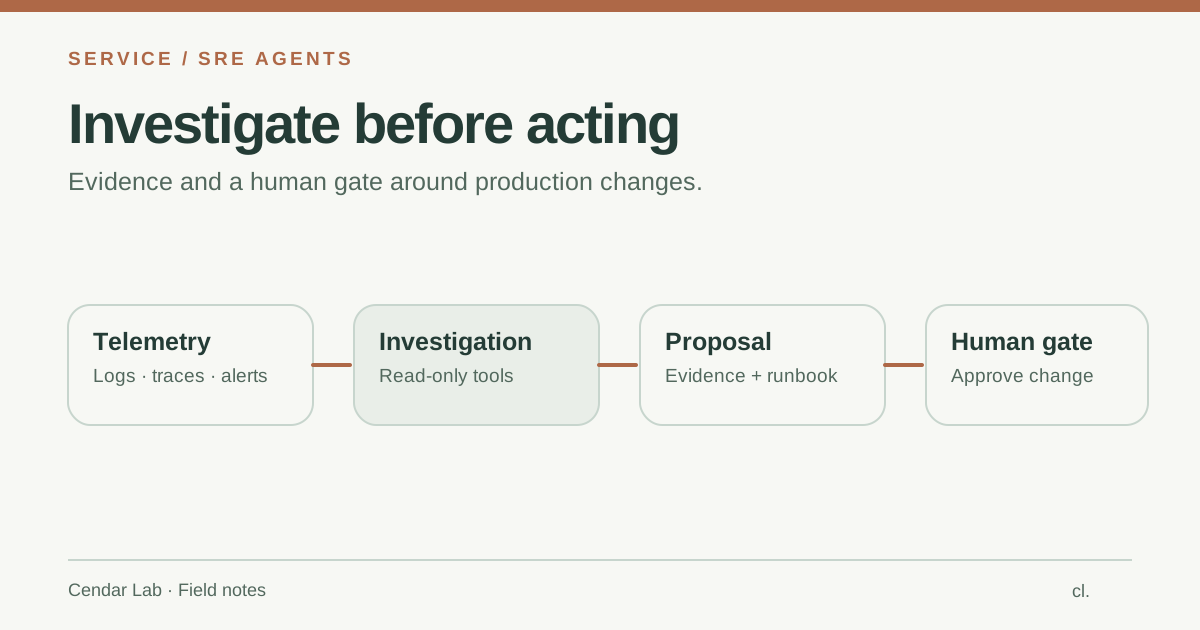
An investigation path with a review gate. Actual tools and permissions are scoped per environment.
WHEN THIS WORK HELPS
Put the next useful finding in front of your engineers.
For DevOps, SRE and Platform Engineering teams burdened by alert fatigue, fragmented monitoring dashboards, or looking to automate incident investigation.
On-call engineers lose critical minutes piecing together logs, traces and metrics across disparate tools.
Alert fatigue causes critical degradation signals to be drowned out in Slack channels.
Uncontrolled scripts and ad-hoc automation create production risks without audit logs or rollback plans.
Incident post-mortems duplicate effort because diagnostic findings remain buried in private threads.
SCOPE AND OUTPUTS
Investigate. Review. Act.
We agree on access, deliverables and checks for your environment.
Safe agent boundary & tool definition
Define read-only observability access via MCP (Model Context Protocol) and typed APIs, preventing unauthorized modifications to production infrastructure.
Deliverable: Scoped tool manifests, permission matrices and sandboxed execution runtimes.
Telemetry source review
Identify the logs, metrics and traces available in the current environment. Scope read-only access and test whether they support a useful incident timeline.
Deliverable: Source map, access plan and a reviewed timeline prototype.
Runbook synthesis & diagnostic execution
Equip agents to follow diagnostic runbooks, query system status, verify health checks and propose verified hypotheses with concrete evidence.
Deliverable: Executable diagnostic playbooks and structured root-cause draft templates.
Human approval gate
Present the exact proposed action, evidence and recovery plan in the team's approved channel before any production mutation.
Deliverable: Approval contract, audit record and tested rejection path.
HOW THE WORK PROGRESSES
A clear handover at each step.
01
Audit incident surface and runbooks
Catalog current alerts, recurring incidents, monitoring tools and escalation paths to identify the highest-leverage diagnostic workflows.
02
Enforce strict permission boundaries
Establish read-only API credentials and define immutable safety boundaries: agents may inspect, correlate and propose, but never commit writes unilaterally.
03
Implement diagnostic tools and agents
Build and test the investigation loop against historical incident logs to ensure accurate root-cause hypothesis generation.
04
Shadow testing during active shifts
Run the agent in shadow mode alongside on-call engineers, refining synthesis accuracy before enabling interactive notification workflows.
BEFORE WE START
Questions to settle early.
Price, timing, access and support follow the agreed project scope.
Can the agent execute write commands or restart servers on its own?
No. By architectural design, our autonomous SRE workflows enforce read-only exploration. Any remediation command requires explicit interactive approval from a human engineer.
Which monitoring platforms and tools can be integrated?
We review the APIs, access and data quality of the monitoring tools you already use. The first scope names the exact sources and operations to connect.
How do you prevent incorrect diagnostics during an outage?
We show the underlying query, timestamp and result for each proposed finding, then test the agent against known incidents and require human review for consequential actions. No model can guarantee a correct diagnosis.
Does this replace human on-call engineers?
No. It can prepare evidence and possible next steps. The on-call team remains responsible for incident decisions and production changes.
How are credentials and infrastructure tokens managed?
The design should use scoped identities and keep credentials out of model context. The actual secret store, token lifetime and audit controls are agreed for the deployment environment.