Cendar LabAEO. Marketing. AI engineering.Discuss your project

VOICE AI DEVELOPMENT & INTEGRATION

Turn incoming calls into a clear next step.

Build voice workflows that capture the right details, connect with your business systems and bring in a person when the conversation needs one.

Share your goals. We’ll help define the next project.

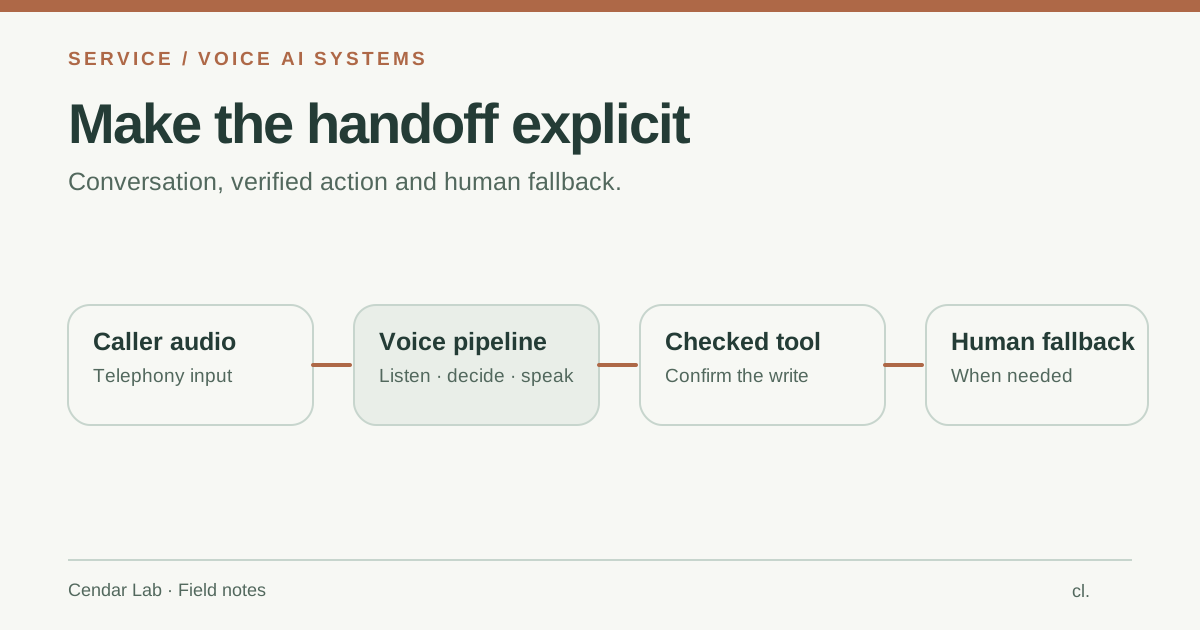
Illustrative voice workflow from caller audio through the voice pipeline and a checked tool to human fallback.
Illustrative call flow. The actual telephony and handoff depend on the systems in scope.

WHEN THIS WORK HELPS

Make the conversation work for the caller and your team.

For engineering and operations leaders deploying voice agents for high-stakes intake, dispatch, appointment booking or customer support. We prioritize latency, reliability and human oversight.

  • The caller waits through speech recognition, model response and speech output delays.
  • Unstable connections interrupt audio or make it difficult to recover a call.
  • A spoken confirmation can arrive before the calendar or CRM confirms a write.
  • A failed transfer can leave the caller without a clear next step.

SCOPE AND OUTPUTS

Connect the parts of a useful voice workflow.

We agree on access, deliverables and checks for your environment.

Streaming voice pipeline architecture

Design real-time speech-to-speech pipelines using WebRTC, SIP trunking, fast STT streaming, speculative LLM inference and chunked TTS synthesis with latency benchmarking.

Deliverable: End-to-end pipeline blueprint, benchmarked roundtrip latency and failover topology.

Deterministic tool validation & guardrails

Constrain model parameters with strict JSON schemas, idempotency keys and pre-execution validation before state mutations occur in your database or calendar.

Deliverable: Validated tool schemas, type-safe API bridges and simulated load tests.

Telephony & PBX integration

Bridge existing phone infrastructure (Twilio, LiveKit, Telnyx, Asterisk) with SIP trunks, DTMF handling, call recording compliance and warm transfers to human agents.

Deliverable: Integrated SIP connectors, call routing rules and graceful transfer fallbacks.

Audio telemetry & observability

Track turn-by-turn latency (TTFT, speech-to-speech), audio quality MOS, interruption rates and full audit trails of tool invocations without storing unconsented audio.

Deliverable: Real-time metrics dashboards, alert definitions and compliance audit logs.
HOW THE WORK PROGRESSES

A clear handover at each step.

  1. 01

    Scope the conversation boundaries

    Define the exact operational boundaries: allowed actions, mandatory disclosure, privacy constraints and human escalation triggers.

  2. 02

    Benchmark latency and streaming

    Measure end-to-end speech-to-speech latency across simulated network conditions, tuning chunk sizes and model inference parameters.

  3. 03

    Integrate tools and telephony

    Wire backend APIs, CRM records and phone trunks with strict validation, retry backoffs and deduplication guarantees.

  4. 04

    Harden and deploy in stages

    Run synthetic multi-caller stress tests, verify operator transfer under failures and roll out gradually behind feature flags.

BEFORE WE START

Questions to settle early.

Price, timing, access and support follow the agreed project scope.

What latency can you promise?

We set a target after testing the selected models, network path and telephony provider. End-to-end call latency must be measured with the actual workflow; no single target fits every system.

What happens when a caller asks to speak with a human?

We define the escalation path and test the transfer with the selected provider. If a transfer fails, the call should have a documented fallback rather than an invented confirmation.

Can Voice AI connect to our existing phone numbers and PBX?

We review the provider's SIP, WebRTC or API capabilities and the access available on your plan before committing to an integration.

How is caller data protected?

Retention, access, recording and redaction depend on the selected providers and project requirements. We define and test those controls before processing real calls.

Will you guarantee 100% natural conversation?

No. Real-time voice models can still mishear accents or misinterpret ambiguous requests. We design explicit clarification loops and easy human escape hatches instead of pretending the system is infallible.

START WITH THE CONTEXT

Primary guidance to review for your implementation:

START WITH YOUR QUESTION

What should your next call accomplish?

Tell us what you want to improve. We’ll review your goals and discuss the next step.

A USEFUL FIRST MESSAGE

“Our support line handles appointment questions. Can we scope a voice flow with a clear transfer to a person?”

What happens after you send it?We review your description and reply with questions about your project. No calendar booking or newsletter signup.

Your project, in a few sentences.

No technical brief needed to start.

Your project inquiry
Required
Required
Required

Describe the call scenario, existing telephony and when a person should take over. Avoid sending recordings or caller data.

Add project details (optional)
Optional
Optional
Optional

Please do not send passwords, API keys, confidential documents, or sensitive personal information.