The short answer
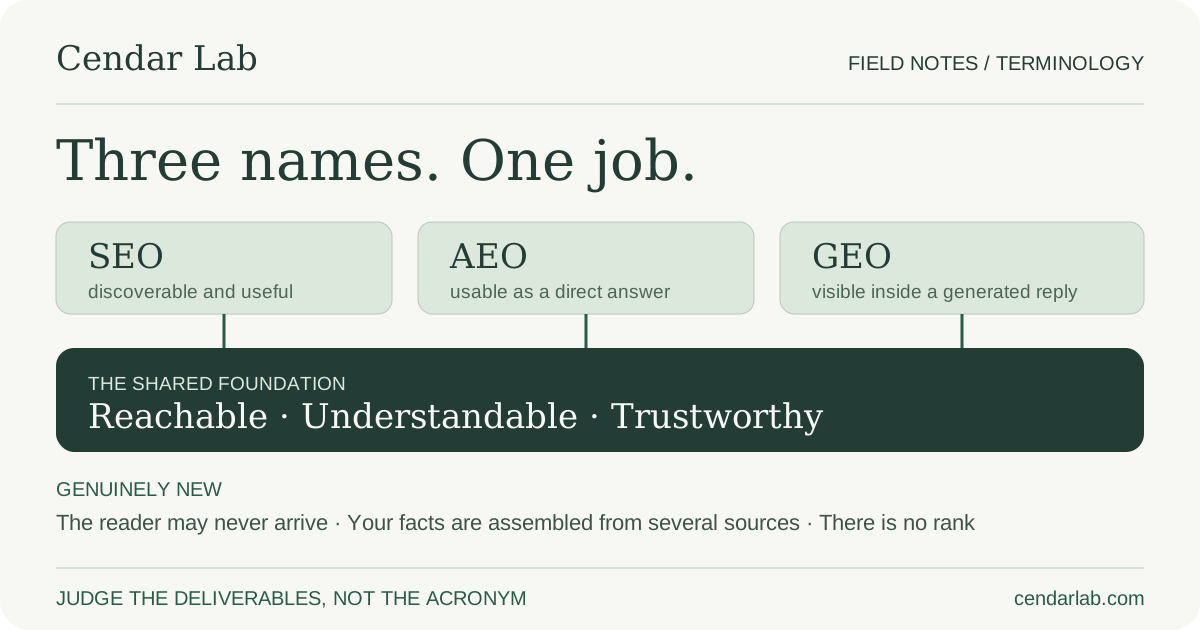
Three acronyms, one underlying job, two genuinely different origins. SEO is the established discipline of making content discoverable and useful through search. AEO, Answer Engine Optimization, is a practitioner term for making content usable as a direct answer rather than as a link someone might click. GEO, Generative Engine Optimization, comes from a 2024 research paper that studied how content can be optimized for visibility inside generated responses.
If you are trying to decide what to buy or what to prioritize, the terminology is largely a distraction. The overlap between the three is substantial, the differences that matter are practical rather than definitional, and vendors use all three words inconsistently enough that the label on a proposal tells you almost nothing about what is inside it. What follows is where each term came from, what genuinely changed about the work, and how to read a proposal without being sold a rebrand.
This is not a neutral position and it is worth saying so. We describe our own marketing specialty as AEO, because the word points at the thing we think is different: the reader may never arrive, and the answer has to survive being extracted. We do not think that choice makes the other terms wrong, and we do not think a client should pay differently because of which one appears on an invoice.
References: Aggarwal et al. — GEO: Generative Engine Optimization (KDD 2024)Google Search Central — AI features and your website
Where GEO actually comes from
GEO has a citable origin, which makes it unusual in marketing vocabulary. The term was introduced in “GEO: Generative Engine Optimization” by Aggarwal, Murahari, Rajpurohit, Kalyan, Narasimhan and Deshpande, published at the ACM SIGKDD conference in 2024. The paper frames generative engines as systems that combine information from several sources into a single response, and studies how the length, distinctiveness and presentation of a cited source affect how visible that citation actually is within the answer.
That framing is more interesting than the acronym it produced. The paper's central observation is that being cited is not binary. A source can be named in a response and still be functionally invisible, buried in a clause, while another source shapes the substance of the answer. Visibility inside a generated response is a matter of degree, and the study proposes ways to measure and improve it.
What the paper is not is a service category. It is a black-box optimization study, written by researchers, evaluated against a benchmark. Between publication and the present, the three letters were detached from that work and reattached to consulting offers, most of which do not reference the paper and some of which contradict it. This happens to research terminology regularly. It is worth knowing about because it changes how you should read a proposal that leads with the word: the term carries academic authority its commercial usage has not necessarily earned.
There is a reasonable position that GEO is the more accurate name for the current moment, since generative engines are what people actually use. There is an equally reasonable position that the distinction between an answer engine and a generative engine is one most buyers cannot act on. Both are defensible. Neither changes what should appear in a statement of work.
References: Aggarwal et al. — GEO: Generative Engine Optimization (KDD 2024)
Where AEO comes from
AEO is older than the current wave and has no single citable origin. It emerged among practitioners during the period when search results started answering questions in place rather than only listing links: featured snippets, knowledge panels, and voice assistants reading a single response aloud. The problem it named was that a page could be the best source on a topic and still lose the interaction, because the answer had been extracted and delivered without a visit.
That is why the term transferred cleanly to assistants. The mechanism changed considerably, but the strategic problem did not: your content is being used to answer a question somewhere you cannot see, and your job is to make sure it is used accurately and attributed to you. The disciplines AEO accumulated in the snippet era, such as answering the question early, writing self-contained passages, and structuring content so an extractable unit makes sense alone, turned out to be directly applicable.
The weakness of the term is that “answer engine” was never precisely defined, and it has been stretched to cover everything from schema markup to publishing on forums. When you see AEO on a proposal, the word is not the information. The deliverables are.
Its strength is that it keeps the reader in the frame. An answer engine is defined by what the person asking gets, not by the architecture that produced it, and that is the right thing to stay focused on when the underlying systems keep changing shape. A term built around the technology needs replacing every time the technology moves. A term built around the interaction survives longer, which is the practical reason we still use it.
References: Google Search Central — AI features and your website
What all three actually share
Strip the labels and the same foundation appears underneath every serious version of this work, which is convenient, because it means most of what you invest in is not a bet on which acronym wins.
Your content has to be reachable. That means crawlable pages, resolvable URLs, HTML that contains the content rather than assembling it afterwards, and deliberate decisions about which crawlers may reach you. Google's own guidance on AI features states the position plainly: the same foundational SEO practices apply, with no additional requirements and no special files or schema needed to appear.
Your content has to be understandable. A clear question, an answer stated early, headings that describe what is actually below them, and passages that make sense when read alone. This is the part AEO emphasizes and the part that most improves a page for human readers too, which is a useful test: if a change would make the page worse for a person, it is unlikely to be the optimization it claims to be.
Your content has to be trustworthy. Specific claims with sources, identifiable authorship, and a consistent account of who you are and what you do. Google's helpful-content guidance and its structured data policies both converge on the same requirement from different directions: the machine-readable description has to match what a visitor can see, and the page has to be written for people rather than assembled to satisfy a formula.
That is the large majority of the work, and it is the same work under all three names. A proposal that is mostly this, described concretely, is probably a good proposal regardless of its cover page.
References: Google Search Central — AI features and your websiteGoogle Search Central — Creating helpful, reliable, people-first contentGoogle Search Central — General structured data guidelines
What genuinely changed
Three things are different enough to justify treating this as its own practice rather than a subheading under SEO. None of them is a new file format.
First, the interaction can complete without you. A reader can get what they needed from a passage of your page rendered inside someone else's interface, and never load your site. This changes what a page has to accomplish. It is no longer sufficient for a page to be persuasive once someone arrives; the extractable passage itself has to be accurate, self-contained and attributable, because that passage may be the entire encounter. Content that only makes sense in the context of the surrounding page is at a structural disadvantage.
Second, your representation is assembled from multiple sources. A search result showed your page. A generated answer describes your company using whatever the system has gathered, which may include your site, a directory listing, an old press release, a forum thread and a competitor's comparison page. Inconsistency across those sources is now a direct problem rather than an untidiness. A service you renamed two years ago, still described under the old name in three places, produces a confused answer that you cannot correct by editing your own page alone.
Third, there is no rank. This is the change that breaks the most reporting. A search position is observable, stable enough to track, and comparable over time. An assistant's answer varies between runs, between accounts, between phrasings of the same question, and between whether the system searched the web at all. Any method that reports a single visibility number without a recorded sample, date, system and question set is producing a number, not a measurement.
References: Aggarwal et al. — GEO: Generative Engine Optimization (KDD 2024)Google Search Central — AI features and your website
What did not change
Nobody can guarantee you a citation. No provider controls what a generative system says about you, and any proposal containing a guaranteed placement in AI answers is describing something its author cannot deliver. The same was true of guaranteed first-page rankings, and it is true for the same reason: the platform decides, and the platform has not agreed to anything.
Thin content is still thin. Publishing more articles about the same question in slightly different words did not work before and does not work now; if anything, a system that synthesizes across sources is a worse audience for near-duplicate pages than a ranked list was. The incentive to consolidate overlapping pages has gone up rather than down.
Technical foundations still decide whether any of it matters. A page that returns the wrong status code, redirects inconsistently, is blocked by a directive nobody remembers writing, or renders its content only after a script executes is invisible to the systems in question. We keep finding that the highest-value item on an AEO engagement is an ordinary technical fix, and this is not a sign that AEO is fake. It is a sign that the foundation is genuinely the foundation.
And attention is still earned. A specific, well-evidenced answer to a question someone actually has remains the thing that works, across every interface this industry has produced. The acronyms are arguments about which surface matters most this year.
References: Google Search Central — Creating helpful, reliable, people-first contentGoogle Search Central — General structured data guidelines
This argument has happened before
It helps to recognize the pattern, because the industry has run this cycle several times and the shape is consistent. A new surface appears between the searcher and the result. Practitioners notice that the old playbook does not fully describe it. Someone coins a term. The term is initially precise and describes something real. Within a year or two it has been stretched to cover the whole discipline, attached to a service offering, and used to imply that everything previously known is obsolete.
Meta keywords went through this in the other direction: a real mechanism that stopped working, whose corpse was sold for years afterwards. Featured snippets produced a wave of position-zero specialists, most of whose actual advice was to answer the question near the top of the page in a self-contained paragraph, which was good advice then and remains good advice now. Voice search produced confident predictions about the end of typed queries and a large quantity of content optimized for questions nobody asked aloud.
In each case two things were simultaneously true. The surface genuinely changed, and the underlying work changed far less than the vocabulary implied. Practitioners who quietly kept doing the fundamentals came out ahead of both the people who ignored the change entirely and the people who reorganized their entire practice around the new acronym.
The current cycle is larger, because generated answers change the interface more thoroughly than a snippet box did. But the same discipline applies: identify the specific mechanism that actually changed, adapt to that, and be suspicious of anyone whose description of the change conveniently requires buying their new thing.
The tell is usually the word “everything”. Everything you know about search is obsolete. Everything must be rewritten for AI. Everything needs a new file. Genuine changes are specific, and specific changes are describable without that word.
References: Google Search Central — Creating helpful, reliable, people-first contentGoogle Search Central — AI features and your website
What this costs, and where the money should go
If the acronyms overlap this much, the natural question is why proposals under the newer ones so often cost more. Sometimes the answer is legitimate: measuring visibility inside assistants is genuinely more laborious than pulling a rank report, because it requires a defined question set, repeated runs, recorded conditions and manual review of what each citation actually supported. That is real work and it deserves to be paid for. Ask to see the method and you will quickly learn whether you are paying for it or for the word.
Sometimes the answer is that a subscription to a visibility tool has been bundled into the engagement. Those tools can be useful, and they can also produce a confident index whose construction is undisclosed. Before paying for one, ask what it sampled, how often, against which systems, and what it does when an answer varies between runs. A number with no denominator is not a measurement, whatever the dashboard looks like.
In our experience the highest-value line item on this kind of engagement is rarely the content program. It is the boring technical review that finds the template returning the wrong canonical address, the section of the site that has been excluded by a directive nobody remembers writing, or the four overlapping articles that should be one. Those findings cost little to produce and change what is possible for everything downstream, which is why we start there rather than with an editorial calendar.
Budget accordingly: a defined review first, then a small number of genuinely needed pages, then measurement designed before the results arrive. If a proposal inverts that order, ask why.
References: Google Search Central — AI features and your websiteGoogle Search Central — General structured data guidelines
How to read a proposal
Since the words do not discriminate, evaluate the contents. These questions separate a substantive engagement from a rebrand with a higher rate card.
- What are the deliverables, named as artifacts? “An AEO strategy” is not a deliverable. A question map, a set of page briefs, a list of URL-level findings with owners, and a measurement definition are.
- What is the measurement method, in enough detail to repeat? Ask which systems, which questions, how many runs, on what dates, and what counts as a citation. If the answer is a proprietary score, ask what it is a score of.
- What is claimed as an outcome versus an activity? Publishing twelve articles is an activity. Ranking, citation and revenue are outcomes nobody controls. A proposal that prices activities and reports outcomes honestly is more trustworthy than one that promises both.
- Does it require a new platform, a new file or a subscription to a visibility tool before anything improves? That ordering is usually backwards, and platform guidance says explicitly that no new machine-readable file is required to appear in AI features.
- What happens to your existing content? A plan that only adds pages, and never consolidates or retires anything, has not looked at what you already have.
- Who writes it, and can they be identified? Content whose authorship cannot be established is the content least likely to be trusted by the systems this work is aimed at, and by readers.
References: Google Search Central — AI features and your websiteGoogle Search Central — Creating helpful, reliable, people-first content
What to ask for instead of an acronym
In practice, the first useful engagement is rarely a content program. It is a review that establishes what is actually true about your site right now: which pages exist, what each one is for, which are reachable, which claims can be supported, which overlap, and what a reader or an assistant would currently conclude about your company from the public record. That produces a prioritized list of specific work, and the specific work is usually a mix of technical fixes, consolidation and a small number of genuinely missing pages.
Then agree on how you will know whether it worked, before it starts. Establish what is measurable today, name what is not measurable and will stay that way, and write down the question set and conditions you will re-run later. Measurement designed after results arrive tends to find whatever the author hoped for.
Then do the ordinary work, well, for long enough to observe something. The parts that survive scrutiny are the same parts under any name: pages that answer real questions, evidence a reader can check, facts about your organization that agree with each other, and technical foundations that let the whole thing be found.
One practical note on sequencing, since it is where most programs go wrong. Teams tend to start with the content calendar because it is the most visible artifact and the easiest to approve. It is also the part most likely to be wasted if the foundations are broken, because publishing into a site that cannot be crawled correctly, or that already has three articles competing for the same question, buries the new work alongside the old. Fix what exists, then add.
And keep the review recurring rather than one-off. The systems in question change their behavior, their crawlers and their interfaces on their own schedule, and a configuration that was correct last year can be quietly wrong now. A short quarterly check of the served pages, the crawler directives and the claims on your most important pages costs very little and catches the failures that otherwise present as an unexplained decline nobody can date.
If someone wants to call that AEO, GEO or SEO, it makes no difference to the invoice or the outcome. It only starts to matter when the label is doing work the deliverables cannot.
References: Google Search Central — AI features and your website