A practical definition of Answer Engine Optimization
Answer Engine Optimization, usually shortened to AEO, is the work of making information easier for answer-producing systems to find, interpret and support with a source. That can include clearer writing, better internal navigation, accurate descriptions of an organization and fewer technical obstacles to accessing a page. It does not mean inserting instructions that force an assistant to recommend your company. The publisher controls the material it makes available; the platform controls whether and how that material appears in a response.
For a B2B company, the useful starting point is a decision a prospective customer needs to make. Someone evaluating a data integration might ask what information must be mapped before implementation. Someone considering an AEO project might ask how citations can be measured without confusing them with traffic. A page earns its place by helping with that decision, whether the person arrives through a conventional search result, an assistant, a colleague's link or the site's own navigation.
The term AEO is used differently across the industry. Some teams emphasize short answers, some focus on generative search visibility, and others include voice interfaces or knowledge management. Define the scope of your own project instead of assuming that the acronym specifies a deliverable. This guide uses AEO to describe discoverable, understandable and evidence-backed web information. It is an editorial and engineering approach, not a product certification, a guaranteed distribution channel or a replacement for the rest of marketing.
References: Google Search Central — AI features and your website
Why AEO does not replace SEO
Google's guidance for AI Overviews and AI Mode is explicit: existing SEO best practices remain relevant, and there are no additional technical requirements specific to those features. To be eligible as a supporting link, a page must be indexed and eligible to appear in Search with a snippet. The same guidance warns that meeting requirements does not guarantee crawling, indexing or serving. Treat these as eligibility conditions and useful practices, not a checklist that produces a guaranteed citation when completed.
The overlap is practical. An informative article that cannot be reached through internal links is harder to discover. A useful service page with a conflicting canonical can send mixed signals about its preferred address. Important explanations hidden exclusively in an image are less accessible to readers who need text. These are familiar SEO and web-quality concerns. Calling a project AEO does not make the crawl path, information architecture, mobile experience or accuracy of the visible page irrelevant.
The additional emphasis is often the shape of the question and the integrity of a claim when it is reused in an answer. Instead of writing a page that merely mentions a service category, explain which situation the service fits, what must be true and where the claim comes from. That benefits ordinary search visitors too. A sensible operating model is one content and technical foundation, with extra observation of answer systems—not two disconnected teams creating competing versions of the same page.
References: Google Search Central — AI features and your website
Separate discovery, understanding and selection
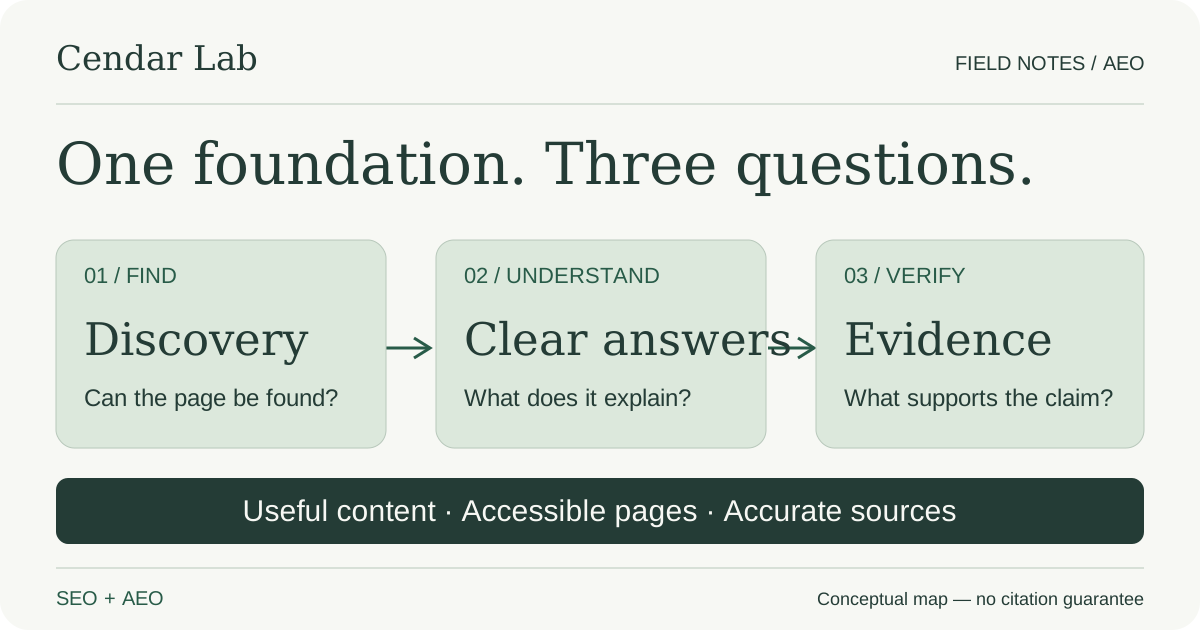
It helps to divide the problem into three questions. Can the platform access or discover the information? Can a reader understand exactly what the page says? And does the system select that source for this particular answer? The first two questions offer many actions a publisher can investigate directly. The third depends on the platform, the request and other available sources. Fixing access or clarity is valuable, but neither lets a publisher promise that selection will follow.
Discovery work includes response status, crawl controls, internal links and a sitemap of appropriate public URLs. Understanding work includes definitions, conditions, authorship, sources, diagrams and consistent names. Selection can vary with the query, product, context and time. Google describes the possibility of query fan-out, in which related searches help assemble an answer. That is not a public formula for reverse-engineering every result; it is a reason to cover a useful subject coherently rather than stuffing one phrase into every section.
Keep these distinctions in reports. A corrected robots rule is an implementation result. A page appearing in an index is a different observation. A citation in a sampled response is another. A prospect who actually submits a relevant inquiry is a business event. Reporting all four as a single increase in authority hides the mechanism and makes failures difficult to diagnose. Name the state you observed, the source of evidence and the date before interpreting its significance.
References: Google Search Central — AI features and your websiteGoogle Search Central — Introduction to robots.txt
Choose questions that matter to a B2B buying decision
Begin with questions from legitimate customer conversations, product documentation, sales objections and available search data. Do not copy private correspondence into a public brief. Extract the general need and remove identifying details. A good question has a reader and a decision behind it: which integration approach fits a constrained team, what access an implementation needs, or how to distinguish an audit from ongoing execution. A phrase that is popular in a tool is not automatically relevant to the business you can serve.
Separate learning, evaluation and purchasing intentions. A guide defining AEO helps someone understand a practice. A measurement article helps that person evaluate a method. A service landing explains the work a company can commission. These pages may link naturally, but they should not be copies with slightly different headlines. The guide should remain useful if the reader never becomes a customer. The landing should answer commercial questions that an educational definition cannot resolve, such as responsibilities, dependencies and how scope is agreed.
An illustrative B2B example is a consultancy with accurate expertise but a confusing website. Its prospective customer might first ask how to compare implementation providers, then look for evidence of the consultancy's approach, and finally ask what a first engagement contains. Publishing a dozen generic articles about being innovative will not answer those questions. A focused explanation, a documented example and a clear service page make a more coherent journey. This is a planning example, not a claim about a measured customer outcome.
References: Google Search Central — Creating helpful, reliable, people-first content
Make an answer useful even when someone reads only a passage
A direct answer is useful when it preserves its conditions. Start a section with the distinction the reader needs, then explain the context. For example, saying that an API integration can synchronize approved customer fields is more responsible than saying it connects everything automatically. The next sentences should identify dependencies such as API access, field ownership, permissions and failure handling. A short statement that becomes misleading when extracted is not improved merely because it looks concise in a search preview.
Do not turn this principle into a fixed paragraph-length formula. Definitions, instructions, comparisons and risk explanations need different structures. Google does not prescribe a preferred word count for helpful content. A long article is justified when it develops the subject, not when a team believes an extra thousand words unlocks an algorithm. In a substantial guide, headings and a table of contents let readers navigate without sacrificing the detail required to understand constraints, alternatives and implementation choices.
Use tables where the comparison is genuinely parallel. Compare the same criteria across options, define unfamiliar terms and distinguish a vendor's documented claim from your own tested observation. A diagram should clarify relationships that prose alone makes difficult to follow. Its caption should explain whether it is conceptual or empirical. Lists can collect prerequisites or failure cases. These formats improve communication; none is a special command that instructs an answer system to rank the page above another source.
References: Google Search Central — Creating helpful, reliable, people-first contentGoogle Search Central — AI features and your website
Turn expertise into evidence rather than adjectives
A statement that a company is experienced is much less useful than evidence showing what it understands. Evidence can include a reproducible technical example, a decision framework grounded in primary documentation, a carefully scoped implementation record or a customer account published with permission. The standard is not that every article must contain proprietary research. The standard is that readers can distinguish established facts, original observations, recommendations and illustrations without guessing which category the author intended.
Source claims at the point where they matter. If a paragraph explains Google's eligibility rules, link to the official rule rather than a generic home page or an unrelated industry statistic. If your own experiment supports a conclusion, state the environment, version, inputs, method and limitations. A screenshot is only one observation and can omit the conditions that produced it. Do not describe internal work for a related company as an independent client endorsement, and do not turn an illustrative calculation into reported revenue.
Authorship should be equally specific. Identify the organization or person responsible for the content and describe review honestly. An organizational byline is preferable to inventing an expert biography. If AI substantially assisted drafting or structuring, explain that role where readers would reasonably expect to know how the material was produced. Review is still necessary: a fluent summary may merge different products, omit an important condition or cite a source that does not support the attached statement.
References: Google Search Central — Creating helpful, reliable, people-first content
Keep the company and its offers consistent across formats
Readers need to know which organization is speaking and what it actually offers. Keep the business name, relationship to a parent organization, service descriptions and appropriate contact information consistent across the visible page and its machine-readable representation. That does not mean repeating a block of keywords everywhere. It means avoiding situations where the home page describes consulting, the structured data describes a software subscription and a downloadable brochure implies a managed service that has not been approved or deployed.
For each offer, distinguish capability, current availability and evidence of results. A team may have an area of expertise without offering a fixed package for every possible use case. Explain how requirements and pricing are established rather than inventing a universal delivery date. If availability, support coverage or a legal limitation matters to the buyer, make it visible near the claim. The same condition should survive in related PDFs, structured data, email copy and any optional machine-readable discovery file.
Consistency also applies to time. A publication date describes when a page became public; an updated date should reflect a substantive change or verification. Changing a year in a title does not create new expertise. Keep a practical review trigger for time-sensitive material, such as a provider policy change or an API release. An older, accurate explanation can be more useful than a newly stamped article that silently relies on obsolete requirements or unsupported examples.
References: Google Search Central — General structured data guidelinesGoogle Search Central — Creating helpful, reliable, people-first content
Use structured data as a description, not a secret sales pitch
Structured data provides a machine-readable description of content and entities on a page. An article can describe its headline, publisher, dates and sources; a service page can identify the service and provider. The visible content must support those statements. Google's general guidelines explicitly reject misleading markup and content that is not visible to users. A syntactically valid block of JSON is therefore only part of validation. Someone must check that it represents the actual page and the real organization.
Do not invent ratings, reviews, prices or credentials to make the markup look complete. Choose a type that fits the content rather than treating every business page as a software application. Keep identifiers stable where the same organization appears on multiple pages. Where possible, generate text and corresponding metadata from the same editorial source to reduce accidental drift. That is an implementation convenience and quality control, not evidence that a search engine will display a rich result or cite the article.
Google's AI-feature guidance says that no special schema.org data or new AI text files are required for those features. An optional file such as llms.txt can summarize public resources, but it should not become a second catalog with different claims or an excuse to neglect navigation. Maintain it only when it has a clear role and can stay accurate. Its existence does not establish inclusion in training, indexing, retrieval or a particular generated answer.
References: Google Search Central — General structured data guidelinesGoogle Search Central — AI features and your website
Treat crawler access and privacy as different decisions
A public marketing site may want search discovery while keeping customer records, account pages and internal tools private. These are different concerns. Robots directives communicate crawl preferences; they are not authentication. Google's documentation explains that a disallowed URL can still appear in search when discovered through links. If a page must remain private, enforce access control. If a public page should not be indexed, use the appropriate indexing control and understand whether the crawler can actually see it.
AI-related crawlers also have different purposes. OpenAI documents separate controls for OAI-SearchBot, which supports search, and GPTBot, which relates to training. It also describes user-initiated access separately. Google likewise distinguishes Googlebot's Search role from Google-Extended controls for some other uses. Do not copy a list of bot names into robots.txt on the assumption that allowing all of them guarantees citations. Evaluate each purpose against the organization's content policy and verify the relevant provider documentation.
The network path matters as well as the file. A content delivery layer can deny access even when robots.txt allows it. A redirect can lead to the wrong host. A preview environment can accidentally become publicly indexable. Test the deployed behavior rather than concluding that configuration in a repository proves what a crawler receives. Access changes should be deliberate, reversible and limited to the intended public material; reputation is not helped by exposing information that should never have been published.
References: Google Search Central — Introduction to robots.txtOpenAI — Overview of OpenAI CrawlersGoogle Search Central — AI features and your website
Connect educational content to a relevant next step
AEO work should help readers move forward, not merely accumulate impressions. The next step depends on the question. A beginner may need another explanation. A technical evaluator may need a checklist or a reproducible example. A buyer may be ready to describe a project. Link to the relevant destination and label it honestly. A guide should not promise an interactive audit if the destination is a generic contact form, and a contact button should not silently subscribe the visitor to ongoing marketing.
For B2B sites, the commercial landing should explain what can be commissioned, what is excluded, which access is required and how success will be evaluated. Show actual proof when it exists and identify illustrative material when it does not. A short, useful inquiry form can start that conversation without demanding confidential documents or a full technical specification. Receipt of the form is still only receipt: qualification, scope agreement, proposal acceptance and payment are separate events owned by the commercial process.
Email can support the relationship when the recipient explicitly chooses it. A reader who subscribes to field notes may want occasional educational updates, not a sales sequence triggered by every page visit. Keep newsletter permission separate from permission to answer a project inquiry. Carry the same accuracy into email subjects and summaries that you expect on the site. Misleading urgency or unsupported results do not become acceptable simply because the content is delivered to an inbox rather than indexed on a web page.
Measure progress without claiming an invisible ranking
Start with a baseline that matches the question. Search Console can describe available search clicks, impressions and queries. A repeatable sample of assistant questions can show whether particular responses mention or cite a URL. Analytics may show identifiable referrals when the request carries that information and collection is permitted. Commercial records can show qualified inquiries and actual contracts. These sources answer different questions. Combining them is useful, but treating them as interchangeable creates claims that the underlying evidence cannot support.
Google says AI-feature traffic is included in Search Console's overall Web reporting. That means an increase in Web clicks is not automatically a separately measured increase in AI Overviews clicks. Likewise, an assistant citation can produce no visit, and a visit may arrive without a recognizable referrer. Report those limits instead of turning missing information into zero. Repeat observations with the question, system, date, language and available search mode recorded so that changes can be interpreted in context.
Business relevance is the final filter. If a new article attracts readers who understand the problem but do not need your service, that can still be a useful editorial outcome. If a landing receives more inquiries but they describe work you cannot deliver, increased volume is not an unqualified success. Review the quality of the journey, not only the count at its beginning. Set targets after observing the baseline and capacity, rather than borrowing a visibility score or conversion promise from another business.
References: Google Search Central — AI features and your website
A sensible first AEO project for a B2B company
A focused first project starts with an inventory, not a publishing quota. Identify the public pages that explain the business, the questions they answer, the sources supporting their claims and the paths to relevant services. Examine a representative set of templates and technical conditions. Classify each issue as an access problem, an unclear answer, an unsupported claim, a confusing journey or an unmeasured outcome. This produces a concrete backlog that different people can own without pretending that every issue is a writing problem.
Select a small number of important pages and define acceptance criteria before editing. For an article, that might mean a distinct question, a complete answer, primary references and working links. For a service landing, it might mean clear deliverables, limitations and a functioning inquiry path. For a technical fix, it might mean the expected status, canonical, robots behavior and rendered content in the deployed artifact. Keep the previous version available and verify the public result after an authorized release.
To run an instant baseline check on your entity resolution, Schema graph structure, /llms.txt discoverability, and AI crawler permissions, run our free deterministic tool: test your website on the Cendar Lab AEO Analyzer (/tools/aeo-checker).
Then observe, revise and expand where there is a justified gap. The goal is not to win an acronym contest between SEO and AEO. It is to build a body of useful information that accurately represents the company and helps people make decisions. Search and answer systems may discover and reference that work, but the company should still stand behind it when someone reads the page directly. That is a more durable foundation for B2B authority than treating citation as something a technical trick can guarantee.
References: Google Search Central — AI features and your websiteGoogle Search Central — Creating helpful, reliable, people-first content