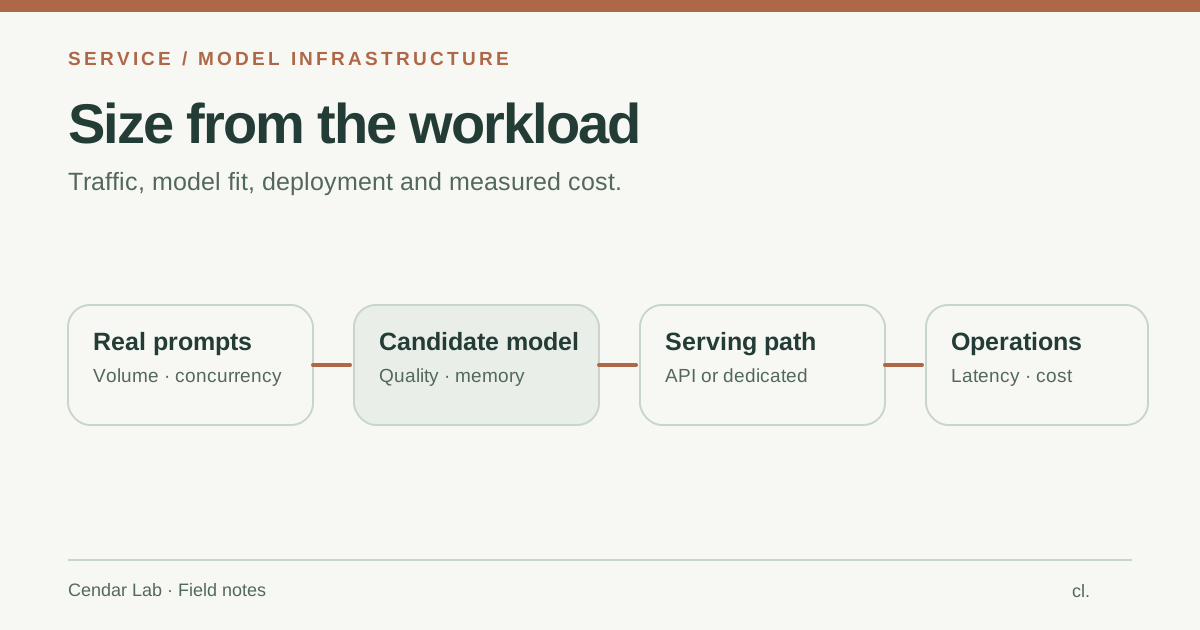
Choose the right mix of model APIs, dedicated inference and cloud infrastructure for your real traffic. Balance response time, model quality and operating cost before committing to more hardware.
Share your goals. We’ll help define the next project.
A sizing sequence, not a claim that a dedicated cluster is always the best choice.
WHEN THIS WORK HELPS
Know what your AI workload costs as usage grows.
For engineering teams whose model traffic, latency or data handling needs justify a fresh serving decision. The actual constraints, legal requirements and operations team determine the scope.
Current API spend may be difficult to predict without prompt and output measurements.
Latency and rate limits need to be checked against the real traffic pattern.
Data handling rules may constrain provider, region, logging and retention choices.
A dedicated service adds GPU, model update and incident response work.
MAKE COST PART OF THE DESIGN
About 1 in 5
Respondents to McKinsey’s 2026 AI survey said operating costs were constraining AI use in their organizations.
Source: McKinsey, August 2026. Survey responses describe organizations’ experience, not projected savings for your deployment.
SCOPE AND OUTPUTS
Find the right balance.
We agree on access, deliverables and checks for your environment.
Workload profiling & hardware sizing
Calculate VRAM requirements, KV-cache sizing, concurrency thresholds and evaluate quantization trade-offs (FP8, AWQ) for your specific latency targets.
Deliverable: Hardware specification, throughput estimates and total-cost-of-ownership model.
Optimized inference engine deployment
Configure vLLM or TensorRT-LLM with PagedAttention, continuous batching, chunked prefill and speculative decoding on dedicated cloud or bare-metal GPUs.
Deliverable: Production-ready container images, deployment manifests and configuration presets.
Autoscaling & traffic routing
Set up intelligent inference load balancing, request queuing and auto-scaling based on real GPU metrics rather than raw HTTP connection counts.
Deliverable: Kubernetes/Docker orchestration with health checks and graceful drain policies.
Telemetry & token cost governance
Monitor tokens-per-second, TTFT, inter-token latency and memory saturation in Prometheus/Grafana, separating operational costs from model experimentation.
Deliverable: Grafana dashboards, alert rules and structured billing attribution.
HOW THE WORK PROGRESSES
A clear handover at each step.
01
Audit workload and token profiles
Profile prompt lengths, generation volumes, concurrency patterns and data sensitivity to establish the right model size and hardware tier.
02
Benchmark on target hardware
Run realistic load tests comparing continuous batching engines and quantization formats against your baseline SLA.
03
Deploy and secure within perimeter
Provision dedicated GPU instances inside your private VPC with strict firewall rules, private endpoints and zero external logging.
04
Handover and operational runbooks
Deliver comprehensive operational guides, upgrade procedures, rollback strategies and monitoring runbooks to your infrastructure team.
BEFORE WE START
Questions to settle early.
Price, timing, access and support follow the agreed project scope.
When does dedicated inference make financial sense?
There is no universal token threshold. Compare API bills with hardware, idle capacity, engineering time, reliability and model quality under your own workload.
Which open-weight models can be deployed?
We shortlist candidates after checking task fit, license, memory needs and evaluation results. A model name alone does not establish production suitability.
Which cloud or hardware option is supported?
We review the infrastructure you already use, region, access and support requirements before selecting a provider or deployment target.
How is data retention controlled?
We map each path where prompts or outputs can be logged, cached, backed up or sent externally. Retention settings and deletion behavior need verification in the chosen architecture.
Do we need an in-house ML team?
Someone must own model upgrades, capacity, incidents and security after handover. The operating plan should name that owner and its support arrangement.