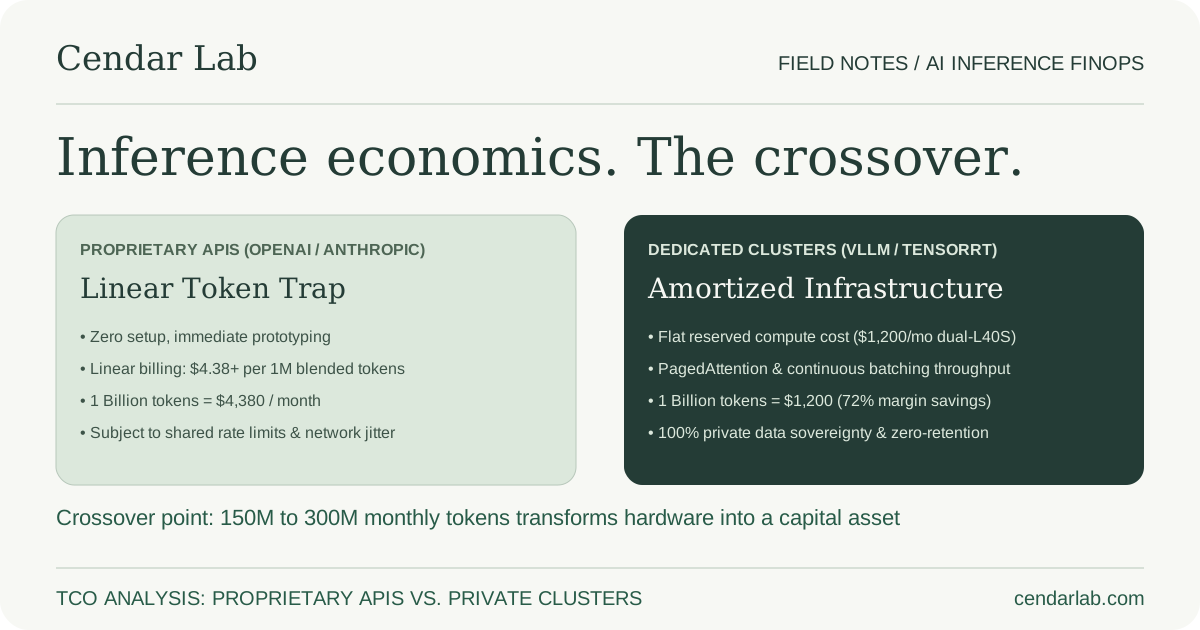
The API dilemma: why linear token billing breaks enterprise software margins
In the initial phases of artificial intelligence adoption, cloud-hosted API endpoints from frontier model providers—such as OpenAI, Anthropic, and Google Vertex AI—represent the logical, friction-free choice for software engineering teams. With zero infrastructure overhead, zero capital expenditure, and a developer onboarding flow that requires nothing more than an API key and a credit card, teams can deploy intelligent conversational interfaces, automated code review assistants, and retrieval-augmented generation (RAG) pipelines in hours rather than months.
However, as an application transitions from an internal proof of concept to enterprise-scale production, this convenience morphs into an acute financial liability known as the linear token trap. In traditional software architecture, computing infrastructure exhibits dramatic economies of scale: a web server or database instance incurs a relatively flat monthly cost whether it serves ten thousand or one hundred thousand requests, meaning marginal costs decline as volume expands.
With pay-per-token API consumption, this economic advantage disappears entirely. Every user interaction, every multi-agent tool calling loop, every semantic document re-ranking, and every context window expansion incurs a strictly linear incremental charge. In autonomous agent architectures, where a single user prompt frequently triggers an autonomous chain of ten to twenty internal agent-to-agent deliberations and recursive tool calls, a single complex task can consume hundreds of thousands of tokens before returning a final answer. At scale, the resulting API invoices erode SaaS gross margins, transforming what appeared to be a high-margin software business into a low-margin reselling wrapper.
Beyond the financial balance sheet, proprietary API dependencies introduce severe operational constraints. Engineering teams find themselves subjected to arbitrary tier-based rate limits (Tokens Per Minute and Requests Per Minute), unpredictable latency spikes during peak commercial hours across shared multi-tenant clusters, and sudden model deprecation cycles that break carefully tuned system prompts. Furthermore, regulated industries such as healthcare, financial banking, and defense face insurmountable data privacy hurdles: sending proprietary intellectual property, patient records, or financial transaction logs to external public endpoints creates compliance liabilities under GDPR, HIPAA, and SOC2 frameworks.
References: OpenAI — API Model Pricing and Enterprise Token EconomicsGoogle Search Central — AI features and your website
The memory wall: PagedAttention, KV cache bloat, and batching dynamics
To understand why private, self-hosted large language model inference was historically deemed inefficient—and why recent architectural breakthroughs have upended that assumption—one must analyze the memory bottleneck inherent in autoregressive transformer generation. In standard deep learning inference, such as image classification or convolutional object detection, computational throughput is primarily bound by raw floating-point operations (FLOPs). Large language models, by contrast, are fundamentally memory-bandwidth bound during token generation.
During autoregressive generation, a transformer model predicts the next token based on all preceding tokens in the sequence. To avoid recomputing the attention key and value vectors for every historical token at every step, the inference runtime caches these tensors in high-speed GPU High Bandwidth Memory (HBM). This structure is known as the Key-Value (KV) Cache. As sequence lengths expand and concurrent user requests proliferate, the aggregate volume of the KV cache rapidly outgrows the model parameters themselves.
In naive inference runtimes, such as early Hugging Face Transformers implementations, memory for the KV cache had to be allocated contiguously in virtual memory up to the maximum theoretical sequence length (e.g., 4,096 or 8,192 tokens) for each request before generation even began. Because real-world customer requests vary widely in length, between 60% and 80% of allocated GPU memory was wasted due to internal and external memory fragmentation. This artificial memory starvation capped concurrency at just a handful of simultaneous streams per GPU, resulting in abysmal hardware utilization and astronomical cost per generated token.
This architectural ceiling was shattered by the introduction of the vLLM project and its revolutionary PagedAttention algorithm, developed by researchers at UC Berkeley. Inspired by classical virtual memory paging in operating systems, PagedAttention divides the KV cache into fixed-size physical memory blocks that can be stored non-contiguously across physical GPU RAM. Dynamic logical-to-physical block tables allow memory to be allocated incrementally as tokens are generated, slashing memory waste to near zero.
To appreciate the mathematical elegance of PagedAttention, consider the physical layout of GPU memory during high-concurrency generation. Under standard attention mechanisms, when a request arrives with an estimated context length of 4,096 tokens, the memory manager is forced to lock a contiguous 1.2-gigabyte block of HBM specifically for that request's attention keys and values. If the conversation terminates early after only 350 tokens, the remaining 90% of reserved VRAM remains locked and inaccessible to other concurrent threads. Under PagedAttention, memory is allocated in compact logical blocks—typically 16 or 32 tokens per page. As the model emits new tokens, the runtime allocates fresh physical blocks on demand and links them via page tables in GPU memory.
Crucially, PagedAttention unlocks copy-on-write memory sharing across multiple distinct generation sequences. When an application utilizes complex sampling techniques—such as parallel beam search, speculative decoding with a draft model, or multi-turn agent branching where several parallel agents explore distinct problem-solving trajectories from an identical system prompt—the common historical KV cache is stored in a single physical page set. The divergent agent branches allocate fresh physical blocks only when their generated tokens diverge. This architectural mechanism reduces peak memory consumption by an additional 55%, enabling extraordinary request density on standard server nodes.
Coupled with continuous in-flight batching—where incoming requests are dynamically inserted into active inference batches at iteration boundaries rather than waiting for prior requests to terminate—engines like vLLM and NVIDIA TensorRT-LLM elevate serving throughput by 8x to 24x compared to legacy serving frameworks. This massive concurrency multiplier fundamentally rewrites the unit economics of dedicated hardware, allowing a single modern GPU node to handle thousands of concurrent queries without latency degradation.
References: vLLM Project — High-Throughput and Memory-Efficient LLM Serving with PagedAttentionNVIDIA TensorRT-LLM — Optimized Deep Learning Inference Architecture
Latency profiling: Time to First Token (TTFT) vs Inter-Token Latency (ITL)
When engineering leaders benchmark inference infrastructure, they frequently make the mistake of evaluating performance through a single generalized metric, such as ‘tokens per second’. In real-world enterprise applications, however, user experience and operational throughput are governed by two distinct, independent latency vectors: Time to First Token (TTFT) and Inter-Token Latency (ITL).
Time to First Token (TTFT) represents the duration required for the inference engine to ingest the initial prompt, process all input tokens through the transformer attention layers (the prefill phase), and emit the very first output token. In retrieval-augmented generation (RAG) and document search architectures, where prompt context windows frequently span 8,000 to 32,000 tokens of retrieved enterprise knowledge, the prefill phase is highly compute-intensive. A sluggish TTFT causes conversational interfaces to feel unresponsive, leaving end users waiting seconds before text begins streaming.
Inter-Token Latency (ITL), conversely, measures the time required to generate each subsequent token during the decoding phase. Decoding is fundamentally memory-bandwidth bound: for every generated token, the engine must stream the entire multi-billion-parameter weight matrix from GPU HBM into the compute cores to perform matrix-vector multiplications. For human-facing chatbots and voice synthesis agents, an ITL below 50 milliseconds per token (equivalent to 20 tokens per second) is mandatory to sustain the illusion of instantaneous, human-like dialogue.
Self-hosted dedicated clusters provide engineering teams with granular control over this latency duality. While public API endpoints subject callers to variable queuing latencies, shared compute contention, and cross-continental network round-trips that introduce hundreds of milliseconds of jitter, a local or private cloud vLLM cluster can be tuned specifically for your workload. By colocating inference nodes on low-latency private VPC subnets adjacent to your application backends, network transit latency drops to sub-millisecond levels. Furthermore, advanced optimizations like prompt caching allow shared system prompts and extensive documentation catalogs to be retained in HBM, reducing TTFT by over 75% across repeated agent loops.
References: vLLM Project — High-Throughput and Memory-Efficient LLM Serving with PagedAttentionNVIDIA TensorRT-LLM — Optimized Deep Learning Inference Architecture
Quantization trade-offs: FP16, FP8, AWQ, and GPTQ in production
A major objection historically raised against self-hosting large open-weight models (such as Llama 3.1 70B, Qwen 2.5 72B, or Mistral Large) is the physical footprint required to store model weights in GPU memory. Storing a 70-billion-parameter model in standard 16-bit floating point precision (FP16 or BF16) requires approximately 140 gigabytes of VRAM merely to load the static weights, plus an additional 40 to 60 gigabytes to accommodate the dynamic KV cache under moderate concurrency. This footprint necessitates a minimum cluster of four 80GB A100 or H100 GPUs, carrying substantial monthly hosting commitments.
Modern post-training quantization techniques have fundamentally resolved this constraint, enabling high-parameter architectures to run on dramatically smaller hardware envelopes with imperceptible loss in semantic reasoning or linguistic nuance. The primary quantization methodologies currently deployed in enterprise environments include FP8, AWQ (Activation-aware Weight Quantization), and GPTQ (Generalized Post-Training Quantization).
On current-generation hardware architectures (such as NVIDIA Ada Lovelace and Hopper architectures), native FP8 precision represents the gold standard for production inference. Supported natively by fourth-generation Tensor Cores in H100 and L40S GPUs, FP8 halves memory bandwidth requirements while delivering up to a 2x throughput uplift over FP16, maintaining mathematical parity with full-precision weights across standardized MMLU and GSM8K benchmarks.
For deployments utilizing prior-generation hardware or cost-effective edge clusters, 4-bit weight-only quantization via AWQ offers remarkable efficiency. Unlike naive uniform quantization, AWQ identifies the critical 1% of salient weight channels that preserve model accuracy and retains them at higher numerical precision, quantizing only non-critical weights down to 4 bits. This slashes the memory requirement of a 70B model from 140 gigabytes to just 38 gigabytes. As a consequence, a frontier-grade 70B open-weight model can execute comfortably on a dual-GPU node of affordable NVIDIA L40S or RTX 6000 Ada workstations, lowering hardware procurement costs by more than 60% without degrading task completion rates.
References: NVIDIA TensorRT-LLM — Optimized Deep Learning Inference ArchitecturevLLM Project — High-Throughput and Memory-Efficient LLM Serving with PagedAttention
Hardware topology: evaluating H100, A100, L40S, and cloud providers
Designing an enterprise private inference tier requires selecting the optimal silicon architecture and procurement model. The global AI infrastructure landscape offers a spectrum of GPU accelerators, ranging from multi-million-dollar hyperscale clusters to agile, specialized bare-metal cloud providers.
At the pinnacle of raw performance stands the NVIDIA H100 SXM5 (80GB HBM3). Boasting 3.35 terabytes per second of memory bandwidth, native FP8 Transformer Engines, and ultra-high-speed NVLink interconnects delivering 900 GB/s of bidirectional chip-to-chip communication, the H100 is engineered for massive concurrency and large-scale model parallelism. For organizations generating hundreds of millions of tokens daily with intense real-time latency requirements, an H100 cluster delivers unmatched throughput density per server rack.
However, deploying H100s for modest or intermittent enterprise workloads often represents overengineering and financial waste. The NVIDIA L40S (48GB GDDR6), built upon the Ada Lovelace architecture, has emerged as the workhorse for enterprise inference FinOps. While lacking SXM NVLink interconnects and featuring slower GDDR6 memory bandwidth compared to HBM3, the L40S provides massive FP8 Tensor Core compute at a fraction of the capital and rental cost of an H100. For single-GPU serving of 8B to 14B parameter models, or dual-GPU serving of quantized 70B models, L40S clusters deliver exceptional price-to-performance efficiency.
Let us examine concrete generation benchmarks to validate this hardware selection. When serving a Llama 3.1 8B Instruct model on a single NVIDIA L40S GPU running vLLM with FP8 precision, the system achieves a sustained throughput exceeding 180 tokens per second for a single client, and an aggregate batch throughput exceeding 1,800 tokens per second under high concurrency. When evaluating a quantized Llama 3.1 70B model across a dual-L40S node using tensor parallelism (TP=2), generation throughput settles comfortably between 35 and 45 tokens per second per stream—well above the average human reading velocity of 5 to 8 tokens per second. Unless an enterprise application is serving thousands of simultaneous low-latency real-time voice streams, paying a 2.5x premium for H100 HBM3 interconnects represents unoptimized capital allocation.
Furthermore, the procurement model dictates a substantial portion of your unit economics. Relying on on-demand hourly pricing from major hyperscalers (Google Cloud, AWS, Azure) incurs significant markups, with H100 instances frequently priced between $3.50 and $4.50 per GPU-hour. Specialized GPU clouds (such as Lambda Labs, RunPod, CoreWeave, and FluidStack) offer identical hardware on committed 1-year or 3-year reservation contracts at rates between $1.80 and $2.40 per GPU-hour. For predictable baseload traffic, committed reservations amortize the physical hardware cost down to fractions of a cent per thousand tokens.
References: OpenAI — API Model Pricing and Enterprise Token EconomicsNVIDIA TensorRT-LLM — Optimized Deep Learning Inference Architecture
The TCO matrix: mathematical comparison across token volumes
To ground this architectural comparison in rigorous corporate finance, let us examine the Total Cost of Ownership (TCO) across three distinct enterprise operational tiers: 10 million tokens per month (a pilot or low-volume tool), 100 million tokens per month (a mature internal productivity platform), and 1 billion tokens per month (a customer-facing SaaS core or high-throughput agent fleet).
Consider a standard blended workload assuming a 3:1 ratio between input prompt tokens and output completion tokens. Utilizing prevailing commercial pricing for a leading frontier model (such as GPT-4o at $2.50 per million input tokens and $10.00 per million output tokens, yielding a blended average of approximately $4.38 per million tokens): at 10 million tokens monthly, the proprietary API invoice totals approximately $43.80. At this baseline volume, self-hosting a dedicated GPU server—which carries a fixed minimum infrastructure baseline of $300 to $600 monthly—is financially unjustifiable. The API approach is clearly superior for exploration and small-scale testing.
However, look at the progression as adoption expands. At 100 million tokens monthly, the proprietary API bill scales linearly to approximately $438.00 per month. Simultaneously, a dedicated dual-L40S cloud instance running an optimized, quantized 70B open-weight model costs approximately $550 per month, reaching economic parity while providing total data sovereignty and eliminating rate limits.
The tipping point becomes dramatic at 1 billion tokens per month. The commercial API bill explodes to approximately $4,380.00 every month—amounting to over $52,500 annually. By contrast, that exact same 1-billion-token throughput can be comfortably processed by a reserved dual-GPU A100 or quad-L40S private node costing roughly $1,200 to $1,500 per month in fully managed cloud infrastructure. This yields a direct cash savings of over $34,000 per year—a cost reduction exceeding 70%—while delivering deterministic sub-second latencies and completely insulating corporate intellectual property from external multi-tenant infrastructure.
References: OpenAI — API Model Pricing and Enterprise Token EconomicsvLLM Project — High-Throughput and Memory-Efficient LLM Serving with PagedAttention
Horizontal autoscaling: private cloud orchestration with Kubernetes and vLLM
Operating dedicated inference infrastructure in production does not mean abandoning the elasticity and automated scaling that modern cloud architectures provide. Modern private inference platforms utilize container orchestration frameworks—primarily Kubernetes coupled with specialized controllers like Keda and vLLM Helm blueprints—to achieve horizontal elasticity across fluctuating traffic demand.
In a production Kubernetes deployment, vLLM server instances run as stateless microservice pods exposed behind a high-performance load balancer. Each pod is configured with health probes that monitor GPU temperature, memory utilization, and active queue depth via exposed Prometheus metrics endpoints (such as `vllm:num_requests_waiting` and `vllm:gpu_cache_usage_factor`).
When user traffic surges and waiting request queues exceed predetermined latency thresholds, the Kubernetes Horizontal Pod Autoscaler (HPA) dynamically provisions additional GPU worker nodes from a reserved spot or on-demand node pool. Incoming JSON-RPC and REST requests are distributed across healthy pods using least-connections or KV-cache-aware routing algorithms, ensuring that requests sharing common prompt prefixes are directed to nodes where those contexts are already warm in memory.
During off-peak hours (such as overnight or over weekends), the autoscaler gracefully drains idle pods and terminates compute nodes, scaling down to a minimal warm baseline to prevent infrastructure waste. This hybrid topology combines the cost predictability and security of private dedicated silicon with the operational resilience and elastic flexibility of cloud-native systems.
References: vLLM Project — High-Throughput and Memory-Efficient LLM Serving with PagedAttentionGoogle Search Central — AI features and your website
The strategic decision framework for engineering leadership
Migrating from proprietary APIs to self-hosted dedicated inference is not a dogmatic, all-or-nothing proposition. High-performing engineering organizations adopt a hybrid routing model (*Model Cascading & Tiered Inference*) that matches computational cost to task complexity.
First, audit your organization's token footprint and latency profiles. If your monthly consumption is below 50 million tokens, or if your tasks demand non-deterministic frontier reasoning across multimodal video and voice simultaneously, maintaining managed API endpoints remains the pragmatic choice. Premature optimization into physical hardware management before finding product-market fit squanders engineering cycles.
Second, identify high-volume, repetitive agentic workloads. Tasks such as customer inquiry classification, entity extraction, document summarization, SQL query generation, and code linting do not require massive frontier models. These tasks can be executed with identical or superior fidelity by fine-tuned 8B or 70B open-weight models running on dedicated private clusters at a fraction of the cost.
Third, establish strict data privacy and governance boundaries. If your software handles protected health information, non-public financial records, or proprietary corporate data, the decision ceases to be purely financial. Dedicated GPU clusters provide cryptographic data residency, eliminate third-party data logging risks, and protect your company against regulatory sanctions. The Model Context Protocol (MCP) provides the standardized integration layer; dedicated inference provides the sovereign, high-efficiency engine that makes agent fleets economically viable at enterprise scale.
To calculate your organization's exact crossover point based on your monthly prompt and completion token volumes, compare provider rates and dedicated GPU cluster expenses directly using our free interactive tool: try the Cendar Lab Inference FinOps Calculator (/tools/inference-calculator).
References: vLLM Project — High-Throughput and Memory-Efficient LLM Serving with PagedAttentionNVIDIA TensorRT-LLM — Optimized Deep Learning Inference ArchitectureSchema.org — Structured Data Vocabulary Standard