Jev: a narrower decision interface
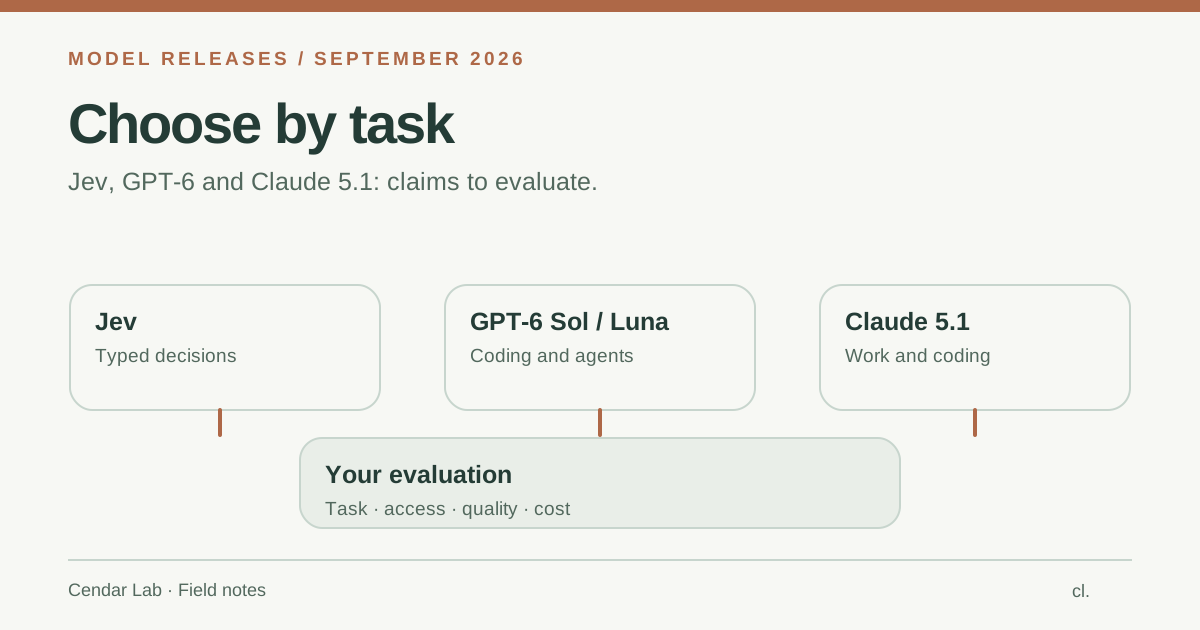
TypeSafe AI announced Jev on September 15 as a System One model for questions about application state. The documented interface asks for typed Choice, Score or Noul answers instead of an open-ended document. That makes Jev a candidate for classification, routing or review decisions with known answer sets.
The release includes provider claims about speed, calibration and price. Teams should check those claims on their own inputs and deployment route. A typed answer can simplify parsing, but a human-reviewed evaluation set and application-owned policy are still needed before an automatic action.
References: TypeSafe AI — Introducing System One Models & Jev
GPT-6 Sol and Luna: new Codex choices
OpenAI's September 22 changelog says GPT-6 Sol and GPT-6 Luna are rolling out to Codex and ChatGPT Work. It positions Sol for complex coding and agentic workflows, and Luna for focused, high-volume tasks. Access depends on the user's plan, rollout and workspace settings.
A useful comparison holds the repository, task, tools, permission settings and acceptance test constant. Track completed tasks, review effort, elapsed time and total cost. If a task needs a different harness or tool policy, document that change rather than attributing the whole result to the model.
References: OpenAI — ChatGPT & Codex changelog
Claude Fable and Mythos 5.1: access and safeguards matter
Anthropic introduced Claude Fable 5.1 and Claude Mythos 5.1 as variants of the same underlying model with different safeguards and access. The announcement presents Fable for general availability and Mythos through a more restricted access route. Its performance charts and customer examples are provider evidence, not a Cendar Lab benchmark.
For a coding workflow, compare the model with the actual Claude Code configuration used by your team. Include tool permissions, context, test execution, review and any time spent correcting a plausible but wrong change. Confirm the specific model and access path before planning a migration.
References: Anthropic — Introducing Claude Fable 5.1 and Claude Mythos 5.1
A release checklist that survives the next announcement
Start with one production-like task set and a baseline. Write down the acceptance criteria before running candidates. For structured decisions, measure errors by class and confidence calibration. For coding agents, review the final diff and tests. For both, record latency, failed calls, retries, cost and the exact release identifier.
Revisit the provider's release and pricing pages when a decision is made. Model availability can vary by plan and region, and names alone do not guarantee a stable configuration. Publish an update to this briefing when a source changes materially, with the review date visible to readers.
References: TypeSafe AI — Introducing System One Models & JevOpenAI — ChatGPT & Codex changelogAnthropic — Introducing Claude Fable 5.1 and Claude Mythos 5.1