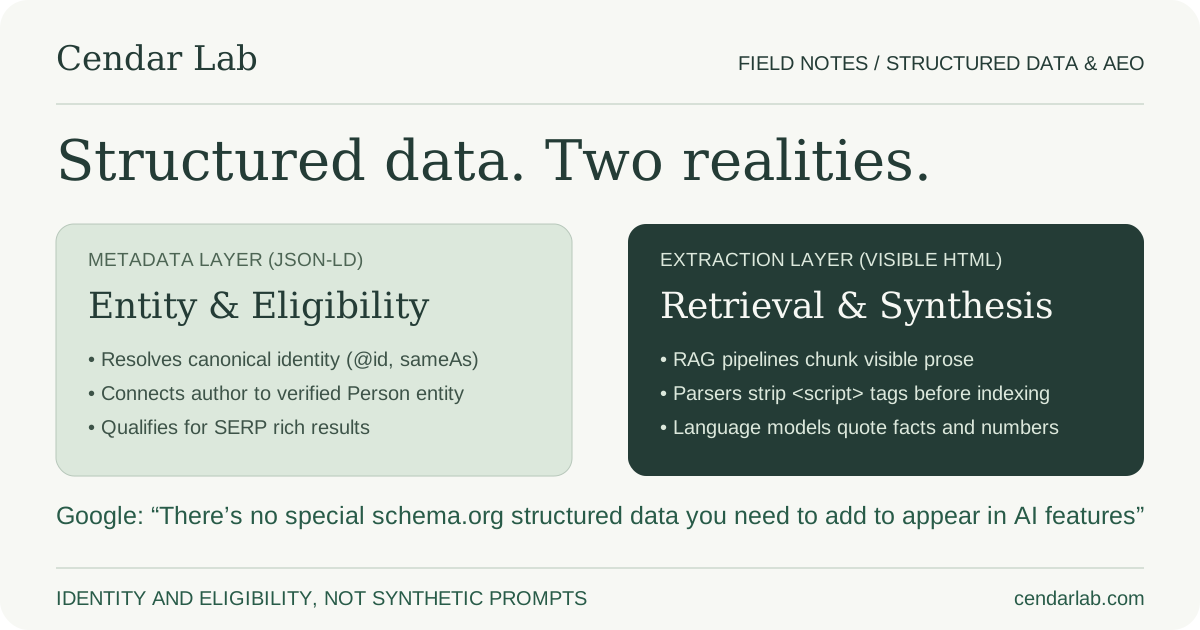
The short answer: schema is an eligibility gate, not an AI prompt
If you are adding Schema.org structured data to your website because an agency told you it will ‘force ChatGPT to cite your brand’ or ‘guarantee inclusion in Google AI Overviews’, you have been sold a story that platform documentation directly contradicts. Google’s official guidance on AI features and your website explicitly addresses this question: ‘There is also no special schema.org structured data that you need to add to appear in these features.’ The same documentation states that eligibility for AI features follows the same standard web search ranking and indexing rules that govern ordinary organic results.
That does not mean structured data is useless in an era of conversational search and autonomous agents. It means its utility has been widely misunderstood and misattributed. Structured data in 2026 performs two concrete, mechanical functions: it establishes machine-readable entity identity so search engines do not confuse your company with someone else, and it provides an eligibility gate for traditional rich results in search engine result pages (SERPs), such as breadcrumbs, review stars, article carousels, and video badges.
What structured data does not do is rewrite reality for an extraction pipeline. When an LLM-based engine—whether it is Perplexity, ChatGPT Search, Claude with web search, or Google’s AI Overviews—constructs a synthesized answer, its primary input is the visible text extracted from the document body, augmented by the semantic graph of known entities. A page with flawed, contradictory, or superficial copy will not be rescued by five hundred lines of pristine JSON-LD buried in the head tag.
This distinction is fundamental to how information retrieval works. Structured data provides explicit metadata about a document; it does not replace the document. When an engineer builds a retrieval-augmented generation system, the vector database indexes semantic chunks of prose, technical definitions, and verifiable explanations. If the prose itself lacks substance, precision, or factual depth, the language model will simply pass over the page in favor of an authority that explains the mechanism clearly.
References: Google Search Central — AI features and your websiteGoogle Search Central — General structured data guidelines
What search platforms explicitly state about structured data and AI
To understand what schema actually does, we have to separate primary platform documentation from conference sales pitches. Google Search Central publishes clear, dated guidelines on both structured data policies and AI features. On the question of AI feature eligibility, Google’s stance has remained consistent: AI Overviews and conversational search features draw from the same core web index that serves standard organic search. There is no hidden schema tag, no proprietary microformat, and no magic JSON-LD namespace that flags content as ‘approved for AI summarization’.
Furthermore, Google’s General Structured Data Guidelines state unequivocally that structured data must be an accurate reflection of the topic and content on the page. The guidelines forbid adding markup about information that is not visible to a human reader visiting the URL. If your JSON-LD claims that your company has a 4.9 rating across 800 reviews, but the visible HTML page contains no reviews or rating summary, that implementation is in direct violation of Google’s structured data policies. Far from helping you appear in AI summaries, structured data that diverges from visible page content triggers structured data manual actions, which strip all rich result eligibility from the domain.
Similarly, documentation from OpenAI for OAI-SearchBot and Anthropic for Claude-SearchBot explains how their respective search crawlers operate. These crawlers parse the document Object Model (DOM), extract clean readable text, index heading hierarchies, and evaluate semantic relevance. While they can parse JSON-LD scripts found within the HTML to extract structured metadata, their answer-generation pipelines are grounded in the body content of the cited sources. Schema assists in entity resolution, but the retrieval augmented generation (RAG) context window is populated by the rendered article text.
References: Google Search Central — AI features and your websiteGoogle Search Central — General structured data guidelinesOpenAI — Overview of OpenAI CrawlersAnthropic — Does Anthropic crawl data from the web, and how can site owners block the crawler?
How retrieval engines and crawler pipelines consume JSON-LD
To evaluate where schema fits into technical architecture, it helps to walk through the actual ingestion pipeline of a modern search or answer engine. When a crawler fetches a web page, it passes the raw HTTP response through an extraction pipeline. For modern crawlers, this involves headless rendering (typically Chromium-based) to execute client-side JavaScript, followed by DOM serialization and document parsing.
During DOM parsing, the engine’s parser splits the document into several distinct data streams. The first stream is the primary content block: headings, paragraphs, lists, tables, and blockquotes located inside semantic landmarks like `<main>` or `<article>`. Navigation headers, footers, sidebars, cookie banners, and advertising slots are classified as boilerplate and either stripped or down-weighted. This clean text stream is what feeds chunking algorithms, dense vector embeddings, and snippet generation pipelines.
The second stream is the metadata extraction layer. This layer reads `<title>`, `<meta name="description">`, Open Graph tags, Twitter card tags, canonical link tags, and `<script type="application/ld+json">` blocks. The JSON-LD blocks are parsed as RDF triples or Schema.org entity graphs. This structured metadata is indexed into the search engine’s knowledge graph. It answers categorical questions: What entity is this? Who is the legal publisher? Who is the attributed author? What is the official date of publication? What is the primary topic of the page?
There is a crucial technical consequence to this separation that many marketing teams miss: almost every standard document extraction library used in modern retrieval-augmented generation (RAG) pipelines—including open-source parsers like Unstructured.io, LangChain document loaders, LlamaIndex readers, and Chromium readability forks—explicitly strips `<script>` elements by default. When an autonomous agent or retrieval pipeline scrapes a URL to answer a user prompt, it intentionally discards script tags to avoid polluting the language model context window with executable code or tracking payloads.
As a result, any factual claim that exists exclusively inside a `<script type="application/ld+json">` tag and is omitted from the visible body copy is literally invisible to the RAG chunking algorithm. The vector database never receives the chunk, the embedding model never indexes the assertion, and the generative synthesizer never sees the claim. Notice the structural division between these two streams. The metadata layer provides classification, relationship mapping, and entity disambiguation. The text layer provides the factual assertions, explanations, nuance, and prose that language models actually quote when generating an answer. Expecting schema to do the job of the text layer is an architectural category error.
References: Schema.org — Structured Data Vocabulary StandardGoogle Search Central — General structured data guidelines
The five schema types that actually earn their keep in 2026
Schema.org defines hundreds of distinct types and thousands of properties. Most of them are ignored by search engines and irrelevant to AI answer engines. In practice, five core schema types deliver almost all verifiable value for technical, B2B, and editorial websites.
| Schema Type | Primary Role | Where Platforms Use It | Common Failure Mode |
|---|---|---|---|
| Organization | Defines the corporate or institutional entity publishing the site. | Knowledge Panels, brand disambiguation, official social profile association via sameAs. | Declaring multiple conflicting Organization nodes on different pages without a consistent @id. |
| Article / TechArticle | Identifies editorial content, authorship, and precise publication dates. | Article rich results, top stories carousels, Google Discover, author entity attribution. | Failing to populate author as a typed Person entity with an external profile link. |
| BreadcrumbList | Maps the hierarchical position of the page within the site architecture. | Clean URL breadcrumb navigation in mobile and desktop SERPs. | Markup array order that contradicts the visual navigation breadcrumb path. |
| FAQPage | Structures discrete question-and-answer pairs. | Rich snippet expansion in supported search queries and direct Q&A entity extraction. | Adding hidden questions to JSON-LD that are not visible to users in the page body. |
| SoftwareApplication | Describes software products, platforms, pricing, and operating systems. | Software snippet badges, rating displays, and technical product indexing. | Claiming arbitrary pricing or free tiers that contradict actual billing models. |
References: Schema.org — Structured Data Vocabulary StandardGoogle Search Central — General structured data guidelines
Schema.org, Open Graph, and Microdata: clearing the protocol confusion
In technical architecture discussions, we frequently observe engineers and content teams conflating three completely distinct standards: Schema.org, Open Graph, and serialization syntax like JSON-LD or Microdata. Keeping their boundaries distinct is essential for clean implementation.
Schema.org is a semantic vocabulary. It defines the names of entities, properties, and relationships—such as `Article`, `author`, `publisher`, and `datePublished`. It is format-agnostic: the same vocabulary can theoretically be represented in JSON-LD, Microdata HTML attributes, or RDFa.
Open Graph, by contrast, is a metadata protocol created by Facebook and now adopted across social platforms and messaging apps like Slack, Discord, LinkedIn, and iMessage. Its purpose is visual presentation when a URL is pasted into a feed or chat thread: it supplies the preview card image (`og:image`), display title (`og:title`), description (`og:description`), and canonical URL (`og:url`). Search engines do not use Open Graph for rich snippet eligibility, and language models do not treat it as a semantic knowledge graph.
JSON-LD (JavaScript Object Notation for Linked Data) is the serialization syntax strongly recommended by Google and the W3C. Unlike Microdata, which forces developers to scatter attributes like `itemscope`, `itemtype`, and `itemprop` throughout their visual HTML markup, JSON-LD isolates the entire semantic graph in a clean, self-contained `<script>` tag. This separation of concerns prevents UI design refactors from accidentally breaking machine-readable structured data. For modern React and Next.js applications, server components can inject a single compiled `<script type="application/ld+json">` payload that encapsulates the full entity graph, avoiding the hydration overhead and HTML bloat associated with legacy inline attributes.
References: Schema.org — Structured Data Vocabulary StandardGoogle Search Central — General structured data guidelines
Entity disambiguation: why identity matters more than markup tricks
Where Schema.org provides genuine, verifiable value in an AI-dominated ecosystem is entity resolution. Language models frequently hallucinate or confuse brands that share similar names, operate in overlapping verticals, or have ambiguous histories. If your company is named ‘Apex Solutions’, there may be thousands of corporate entities with that identical trade name worldwide.
When an AI search engine evaluates whether to cite your publication on a specialized topic, it attempts to resolve the entity behind the content. A properly constructed `Organization` schema resolves this ambiguity by declaring a global, canonical `@id` (typically `https://yourdomain.com/#organization`) and populating the `sameAs` array with authoritative external references: your official LinkedIn company profile, GitHub organization, Crunchbase profile, Wikidata entry, and regulatory filings.
Similarly, for authors, nesting an `author` property within an `Article` schema that resolves to a `Person` entity—complete with a `sameAs` link to their personal website, LinkedIn, or academic profile—enables search engines to connect the content to a verified human with established domain authority. This directly aligns with Google’s Helpful Content and E-E-A-T (Experience, Expertise, Authoritativeness, Trustworthiness) documentation, which emphasizes knowing who created the content and why it can be trusted.
Search engine knowledge graphs rely heavily on entity reconciliation algorithms to merge disparate web observations into a single node. When your structured data provides explicit, machine-readable links to existing knowledge bases like Wikidata or official corporate registries, you save the search engine’s graph builder from relying on uncertain probabilistic guesses. This certainty directly benefits the brand when conversational engines answer categorical questions about who created a product, when a service was launched, or what geographic locations an organization serves.
Conversely, omitting entity markup or allowing conflicting corporate identities to propagate across subdomains forces crawlers to treat your pages as orphaned documents. In that scenario, an answer engine might still quote your text if the query match is exceptionally strong, but it is substantially more likely to omit brand attribution or attribute your findings to an aggregated third-party directory that previously scraped your content.
References: Google Search Central — Creating helpful, reliable, people-first contentSchema.org — Structured Data Vocabulary Standard
The myth of the 'AEO Schema' and agency snake oil
A concerning trend in digital marketing over the past year has been the emergence of agencies selling proprietary ‘AEO Schema packages’. These vendors claim to have discovered secret Schema.org properties or proprietary JSON-LD configurations that supposedly command AI models to prefer their clients’ websites when answering prompts.
It is essential to understand why these claims are technically fraudulent. Schema.org is an open community process managed by the W3C Schema.org Community Group, with open participation from Google, Microsoft, Yahoo, and the broader web community. All recognized types, properties, and enumerations are published openly at schema.org. There are no private or proprietary schemas recognized by search engines. If someone invents a custom property like `aiDirectAnswerTarget` or `answerEnginePriority`, search engine parsers simply ignore it as an unrecognized field during schema validation.
Furthermore, modern language models do not require special markup to extract answers. The entire breakthrough of large language models over the past several years is that they understand natural language text natively. A clear, well-written paragraph that begins with a direct definition and follows with concrete arithmetic is vastly easier for an LLM to comprehend, extract, and cite than an overly complex, nested JSON structure attempting to encode the same thought artificially.
Search engines incur immense computational costs when crawling and indexing billions of URLs. Relying on easily spoofable, unrendered JSON strings as an authoritative ranking signal would introduce catastrophic vulnerability to adversarial manipulation and webspam. This is why multi-stage verification against user-facing copy remains the immutable bedrock of search architecture.
Many of these automated ‘AEO plugins’ also suffer from a severe architectural flaw: they generate fragmented, duplicate entity graphs. In our client audits, we routinely inspect WordPress installations where an SEO plugin, a review widget, and an e-commerce plugin each inject their own independent `@graph` block. One block defines the company under one URL, another defines it under a staging URL, and a third declares an anonymous author. This internal incoherence degrades machine trust far more than having no schema at all.
References: Google Search Central — AI features and your websiteSchema.org — Structured Data Vocabulary Standard
The mismatch penalty: why invisible JSON-LD is worse than no schema
One of the most dangerous practices we encounter during technical audits is ‘shadow content’ in structured data. This occurs when an automated tool or an overzealous marketing team injects extensive FAQ schemas, product ratings, or organizational accolades into the JSON-LD script block that do not exist anywhere on the visible webpage.
Google’s policy on this point could not be clearer: ‘Structured data must be an accurate representation of the content on the page.’ When Google’s automated quality systems or manual webspam reviewers detect a discrepancy between the structured data and the visible DOM, the response is not to simply ignore the extra markup. Google issues a structured data manual action against the site.
A structured data manual action results in the immediate removal of all rich result features across the affected pages or the entire domain. If your site relied on breadcrumbs, article dates, or product badges to stand out in organic search, those features vanish overnight. In addition, platform trust signals are degraded. If a crawler cannot trust your structured data to match your visible text, it has every reason to question the reliability of your factual assertions across the board.
We also see teams attempt to manipulate conversational engines by putting promotional copy or competitive comparisons inside hidden `ItemPage` or `FAQPage` nodes, hoping that an AI crawler will ingest the claim without human visitors noticing the aggressive sales pitch. This tactic fails for the reason outlined earlier: RAG scrapers strip scripts before chunking, while search crawlers cross-validate JSON-LD against rendered text. The only outcome is increased regulatory and search penalty risk.
References: Google Search Central — General structured data guidelinesGoogle Search Central — Creating helpful, reliable, people-first content
A practical engineering checklist for structured data in 2026
Rather than attempting to mark up every noun and verb on your website, engineering teams should follow a strict, disciplined protocol that prioritizes correctness, entity consistency, and zero drift between code and copy.
1. Single source of truth: Never hand-craft static JSON-LD strings in template files. Derive your structured data dynamically from the exact same typed data objects or CMS models that render the visible React or HTML components. If a headline, author name, or FAQ answer changes in copy, the JSON-LD updates automatically, eliminating maintenance drift.
2. Canonical entity IDs: Use stable fragment identifiers for entities. Your primary Organization should have an `@id` of `https://domain.com/#organization`. Your WebSite node should have an `@id` of `https://domain.com/#website`. Every Article on the domain should reference that exact Organization node as its `publisher` via `{"@id": "https://domain.com/#organization"}`, establishing an interconnected graph across the entire domain.
3. Strict schema validation: Integrate schema validation into your continuous integration (CI) pipeline. Use tools like `schema-dts` in TypeScript to enforce type safety, and validate generated output against the official Schema.org schema validator and Google Rich Results Test API before merging code to main.
4. Exact visible parity: Every string present in an `FAQPage` or `Review` schema must be rendered verbatim in the visible HTML. If you use collapsible accordions for FAQs, ensure the text content exists in the rendered HTML DOM on initial load, even if visually collapsed via CSS.
5. Clean serialization in modern frameworks: In Next.js App Router, Astro, or Remix, always serialize JSON-LD using `JSON.stringify` inside a raw `<script type="application/ld+json" dangerouslySetInnerHTML={{ __html: JSON.stringify(schema) }} />` tag. Ensure your serialization logic escapes dangerous HTML characters (specifically replacing `<` with `\u003c` and `>` with `\u003e`) to prevent premature script termination and cross-site scripting vulnerabilities. Never mix Microdata or RDFa inline attributes into React server components when JSON-LD provides a cleaner, decoupled, and less error-prone architecture.
References: Google Search Central — General structured data guidelinesSchema.org — Structured Data Vocabulary Standard
Decision matrix: what to mark up and what to leave alone
Use the following decision matrix to prioritize your structured data engineering efforts. Focus on high-confidence, standard types with proven support, and avoid speculative complexity that adds maintenance overhead without verifiable return.
| Scenario / Content Type | Recommended Action | Primary Schema Types | Expected Outcome |
|---|---|---|---|
| Company Homepage & Brand | Implement comprehensive entity graph. | Organization, WebSite | Knowledge Panel stability, brand disambiguation, verified social entity links. |
| Technical Blog Post / Field Note | Implement article and authorship graph. | Article or TechArticle, Person | Author entity attribution, clear publication timestamps, Article rich snippet eligibility. |
| Service Landing Page with visible FAQs | Implement Service node and visible FAQPage. | Service, FAQPage | Expanded SERP listing for relevant queries, machine-readable service definition. |
| Product Pricing & SaaS Plans | Implement typed software offer schema. | SoftwareApplication, Offer | Accurate currency and tier indexing in technical product comparisons. |
| Generic Marketing Landing Page | Keep markup minimal; rely on clear semantic HTML. | WebPage, BreadcrumbList | Clean breadcrumb rendering without maintenance risk from drifting marketing claims. |
| Third-Party Awards / Unverified Claims | Do NOT attempt to mark up with custom schema. | None (leave in plain text) | Eliminates risk of structured data policy violations and manual spam penalties. |
References: Google Search Central — General structured data guidelinesSchema.org — Structured Data Vocabulary StandardGoogle Search Central — AI features and your website