The cannibalization problem in organic search and AI answer engines
In the rush to capture organic search traffic over the past decade, many content teams adopted an expansionist editorial strategy: publish a separate blog post or landing page for every conceivable variation of a target keyword. A software consultancy might publish ‘What is cloud automation?’, ‘Cloud automation guide’, ‘Benefits of cloud automation for business’, and ‘Cloud automation tools in 2026’. While this approach occasionally captured fragmented long-tail queries in the era of naive keyword matching, it creates severe structural friction in modern search and retrieval environments.
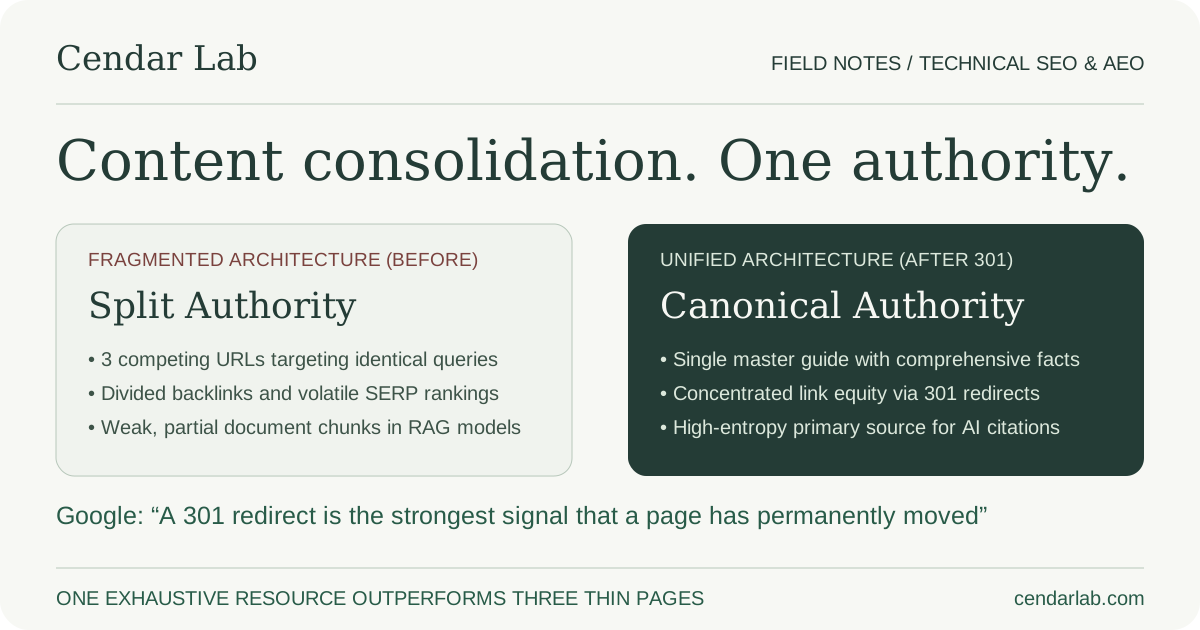
In traditional organic search, having multiple pages on the same domain compete for identical search queries is known as keyword cannibalization. Rather than dominating the search engine result page, the competing URLs split the domain’s internal and external link equity. Search engine ranking algorithms struggle to determine which URL is the definitive authority on the topic, leading to volatile ranking fluctuations where Google alternates between two or three competing URLs from week to week, rarely awarding any of them a top-three position.
In modern AI answer engines and conversational search platforms—such as Perplexity, ChatGPT Search, Claude with web search, and Google AI Overviews—the penalty for content fragmentation is even more acute. Generative answer engines rely on dense semantic retrieval and retrieval-augmented generation (RAG) pipelines that score document chunks for topical relevance, factual density, and authority. When a domain disperses its technical expertise across four thin, overlapping articles, each individual page scores lower on comprehensive topical coverage than a single, exhaustive, well-structured resource.
Furthermore, conversational models synthesize answers from distinct authoritative nodes. When an agent scraper encounters three pages from the same brand offering contradictory definitions, conflicting pricing summaries, or overlapping explanations written at different times by different authors, the model’s confidence in the source diminishes. Far from increasing brand visibility, content duplication leads answer engines to cite a competitor whose site presents a single, coherent, authoritative explanation.
References: Google Search Central — Creating helpful, reliable, people-first contentGoogle Search Central — Consolidate duplicate URLsGoogle Search Central — AI features and your website
How keyword cannibalization manifests in Google Search Console data
Keyword cannibalization is not a theoretical abstraction; it leaves clear, diagnostic footprints in Google Search Console performance reports. By analyzing query-to-page mappings over a 3- to 6-month window, technical teams can mathematically identify URLs that are undermining each other’s organic performance.
The primary symptom of cannibalization is query fragmentation. In Google Search Console, when you filter by a specific high-intent search query and inspect the ‘Pages’ tab, you should ideally see a single primary URL capturing 85% or more of the impressions and clicks. If instead you discover three or four URLs each capturing between 15% and 40% of the query’s impressions, with average positions fluctuating between positions 8 and 25, you are observing active cannibalization.
A secondary symptom is position instability accompanied by low click-through rates (CTR). Because Google’s ranking systems continually test which URL best satisfies user intent, the competing pages frequently trade places in the SERP. In historical ranking charts, this appears as an erratic, saw-tooth graph where URL A ranks at position 6 for two weeks while URL B drops to position 28, followed by a sudden reversal where URL B climbs to position 7 and URL A plummets. This perpetual instability prevents either page from accumulating the behavioral engagement signals required to achieve stable top-three rankings.
A third diagnostic signal is crawler redundancy in server access logs. When a website publishes dozens of overlapping, low-differentiation articles, search engine crawlers spend significant portions of their assigned crawl budget re-fetching near-identical documents. In large websites with thousands of URLs, this crawl inefficiency delays the indexation of newly published technical articles, product announcements, and high-value landing pages.
References: Google Search Console — Performance report overviewGoogle Search Central — Consolidate duplicate URLs
Why AI answer engines penalize fragmented content ecosystems
To understand why content consolidation is a cornerstone of Answer Engine Optimization (AEO), we must examine how modern retrieval pipelines assemble context windows for language models. Unlike human users who might click through multiple search results and synthesize information across tabs, an AI engine operates under strict token budgets and latency constraints.
During the retrieval phase of an answer engine, the user’s conversational prompt is transformed into semantic search queries and evaluated against an inverted index and vector embeddings. The retrieval pipeline retrieves the top-k document chunks—typically between 5 and 20 text passages of 300 to 500 tokens each—and injects them into the model’s prompt context. If a domain’s information is fragmented across multiple overlapping pages, the retrieval system is forced to spend multiple chunk slots ingesting repetitive introductory prose and conflicting definitions from the same site.
Language models favor factual density. A comprehensive, 3,000-word authoritative guide that organizes definitions, code examples, trade-off matrices, and operational checklist into distinct semantic sections produces document chunks with substantially higher information entropy. Each chunk retrieved from an authoritative consolidated guide delivers dense, verifiable facts that the language model can cite directly in its synthesis.
Conversely, when an AI crawler encounters multiple lightweight articles that touch on the same topic without exhausting it, the chunks retrieved are thin and generic. The model’s ranking and reranking algorithms (such as Cohere Rerank or BGE-Reranker) score these fragmented chunks lower than comprehensive third-party documentation. Consolidating overlapping content into a single master reference transforms a collection of weak, competing pages into an undeniable primary source.
Furthermore, modern multi-hop reasoning engines (such as OpenAI o-series or DeepSeek reasoning models) construct step-by-step retrieval paths that trace logical dependencies across sources. When the complete proof or operational explanation is scattered across three separate articles on your website, the probability that the agent's context retriever successfully retrieves all three matching passages without exhausting its context budget drops precipitously. The model either generates an incomplete synthesis or falls back to an external source that articulates the full argument in a unified guide.
References: Google Search Central — AI features and your websiteGoogle Search Central — Creating helpful, reliable, people-first content
The diagnostic framework: identifying candidate URLs for consolidation
Before modifying URL routing or altering page content, engineering and marketing teams must conduct a rigorous content audit to separate legitimate topic clusters from cannibalizing duplicates. Merging content arbitrarily without diagnostic evidence risks destroying pages that serve distinct, valuable user journeys.
The first step is clustering URLs by primary search intent. Search intent falls into four broad categories: informational (seeking an explanation or tutorial), transactional (seeking to purchase or hire), commercial investigation (comparing options or reviewing specifications), and navigational (seeking a specific login or portal). Two pages should only be candidates for consolidation if they target the exact same intent category for the exact same target audience.
The second step is measuring query overlap. Export your Google Search Console query data for the past 90 days. For each pair of suspect URLs, calculate the Jaccard similarity coefficient of their top 25 ranking queries. If two URLs share more than 60% of their top ranking queries, and neither URL achieves a stable average position in the top 5, they are prime candidates for consolidation.
The third step is evaluating backlink and referral equity. Use search console data and backlink audit tools to catalog the external inbound links pointing to each candidate URL. A common finding is that one page holds 80% of the historical backlinks and domain age, while a newer page possesses updated copy but zero external authority. Identifying which page holds the stronger historical authority determines the canonical recipient of the consolidation.
For engineering teams managing large technical websites, this diagnostic process can be automated through a programmatic Cannibalization Index (CI). By exporting Google Search Console data via the Search Console API into BigQuery or a local SQLite database, you can write a straightforward SQL query that flags query-to-URL collisions. When any search query with more than 500 monthly impressions shows two or more URLs from your domain capturing at least 25% impression share each, an alert triggers for editorial review. Tracking this metric across quarters prevents editorial teams from inadvertently publishing competing articles as content volume expands.
References: Google Search Console — Performance report overviewGoogle Search Central — Creating helpful, reliable, people-first content
When to merge versus when to differentiate: four real-world scenarios
Not every pair of overlapping pages should be merged. In many architectural scenarios, the correct technical solution is not consolidation, but aggressive differentiation of scope, audience, or technical depth. The following real-world scenarios illustrate how to evaluate the decision.
| Scenario | Underlying Conflict | Correct Action | Technical Implementation |
|---|---|---|---|
| Two blog posts with near-identical titles written in different years (e.g. 2024 vs 2026) | The newer post was written because the old one decayed, but the old one still holds historical backlinks. | Consolidate into the stronger URL. | Merge updated facts into the canonical URL; implement a permanent 301 redirect from the donor URL; update internal links. |
| An introductory conceptual guide vs an in-depth API reference guide | Both pages rank for the head term, but users arriving at the reference want code, while users at the guide want concepts. | Differentiate; do NOT merge. | Sharpen internal headings; cross-link prominently at the top of each page; optimize title tags for distinct audience intents. |
| Multiple localized city landing pages with near-duplicate boilerplate text | Thin programmatic pages differing only by city name, failing to rank due to low helpfulness scores. | Consolidate regional pages into regional hubs. | Merge hyper-local satellite pages into an authoritative county or metropolitan guide with genuine local case studies. |
| A service commercial page and an editorial blog post answering 'What is [Service]?' | Commercial intent (hire us) conflated with educational intent (learn what this is), splitting organic traffic. | Keep separate and establish clean interlinking. | The blog post answers the educational query and links contextually to the service page; the service page focuses on deliverables and pricing. |
References: Google Search Central — Creating helpful, reliable, people-first contentGoogle Search Central — Consolidate duplicate URLs
The technical consolidation protocol: step-by-step engineering execution
Executing a content consolidation project requires strict operational discipline. Inexperienced teams often make the catastrophic mistake of simply deleting donor pages, which creates a flood of 404 HTTP errors, destroys accumulated backlink equity, and causes severe organic ranking drops. A professional consolidation follows a five-stage engineering protocol.
Stage 1: Content synthesis. Begin by extracting all unique, high-performing text, diagrams, code samples, and data tables from the donor URLs. Synthesize these assets into the recipient canonical page. Ensure that the resulting unified article is comprehensive, logically structured, and substantially more valuable than any of the individual donor pages were in isolation. Verify that the unified document maintains narrative coherence and avoids redundant introductory paragraphs.
Stage 2: Metadata and canonical alignment. Update the title tag, meta description, and Schema.org structured data of the recipient URL to reflect its expanded scope. Ensure the Open Graph metadata, Twitter card tags, and canonical link tag (`<link rel="canonical" href="https://domain.com/blog/unified-slug">`) are fully synchronized and validated against Schema.org guidelines.
Stage 3: Permanent 301 redirection. Implement server-level HTTP 301 permanent redirects from every donor URL to the exact canonical recipient URL. Never use temporary 302 redirects, and never redirect donor URLs to the homepage. In Next.js, configure redirects in `next.config.js` or middleware; on cloud platforms like Cloud Run or Nginx, configure permanent return directives. Test each redirect with `curl -I` to verify that it returns an immediate HTTP 301 status with the correct `Location` header, avoiding redirect chains.
Stage 4: Internal link audit and remediation. Crawl your entire website to identify every internal link that previously pointed to the donor URLs. Update each link in your codebase, navigation menus, footer templates, and markdown files to point directly to the new canonical URL. While a 301 redirect passes equity, forcing search crawlers and users through redirect hops adds latency and dilutes internal PageRank signals.
Stage 5: XML sitemap reconciliation. Remove the decommissioned donor URLs from your `sitemap.xml` immediately. Add or update the canonical recipient URL in the sitemap with a refreshed `<lastmod>` timestamp matching the deployment date. This signals to search crawlers that the canonical page has been substantially revised and invites immediate re-indexing.
Stage 6: Edge CDN cache invalidation and routing verification. When deploying 301 redirects in modern headless architectures—such as Next.js on Cloud Run, Vercel, or AWS CloudFront—you must ensure edge caches do not serve stale cached 200 responses to search engine bots. In Next.js, configure redirects in `next.config.js` with `permanent: true` to generate native HTTP 301 headers. Immediately following deployment, purge the exact donor URLs from your CDN edge cache (Cloudflare, Fastly, or Google Cloud CDN) and verify with `curl -sIL -A "Googlebot" https://domain.com/old-slug` that the edge returns an immediate HTTP 301 with the correct `Location` header, without triggering middleware loops or secondary redirects.
References: Google Search Central — Consolidate duplicate URLsGoogle Search Central — Introduction to robots.txt
Managing 301 redirects, internal links, and sitemap reconciliation
The technical mechanics of HTTP 301 redirection are frequently botched during site migrations and content cleanups. Understanding how search engines process redirect signals is essential to prevent ranking erosion.
According to Google Search Central documentation on duplicate URL consolidation, a 301 redirect is the strongest signal available to indicate that a URL has permanently moved to a new address. When Googlebot encounters a 301 redirect, it schedules the destination URL for crawling, updates its canonical index, and transfers historical ranking signals (including PageRank, external backlink equity, and historical click signals) from the donor URL to the destination URL.
However, this transfer is not instantaneous. Search engines require time to discover the redirect, verify that the destination content genuinely satisfies the historical intent of the donor page, and update the global serving index. If the destination URL serves completely irrelevant content—such as redirecting a technical article on database optimization to a generic company homepage—Google classifies the redirect as a ‘soft 404’ and refuses to transfer the backlink equity.
Furthermore, technical teams must avoid redirect chains and loops. A redirect chain occurs when URL A redirects to URL B, which in turn redirects to URL C. Search engines typically follow up to five redirect hops, but each additional hop introduces latency, increases crawl failure rates, and diminishes the efficiency of signal transfer. Every donor URL should resolve to its final canonical destination in exactly one HTTP hop.
References: Google Search Central — Consolidate duplicate URLsGoogle Search Central — Introduction to robots.txt
Handling content salvage: preserving high-performing sections from donor pages
A common fear among marketing leaders during consolidation is that merging pages will eliminate specific sub-topic rankings that the donor pages previously held. For example, if Donor Article A ranked on page 2 for a secondary question like ‘how much does cloud automation cost?’, will that query be lost when Article A is redirected to the master guide?
The solution is deliberate content salvage. Before deprecating a donor page, technical teams must audit all queries for which the donor page currently generates impressions in Google Search Console. Any valuable sub-topic, specialized calculation, or unique perspective present in the donor page must be explicitly integrated into the recipient master guide under a dedicated H2 or H3 heading.
By structuring the recipient article with semantic heading landmarks (such as `<h2 id="cost-and-budgeting">Cost and Budgeting Considerations for Cloud Automation</h2>`), you create distinct, linkable anchor fragments within the master document. Modern search engines are fully capable of ranking specific sections of a comprehensive long-form article for targeted long-tail queries, using passage ranking and direct jump-links in search snippets.
This salvage process ensures that the consolidated page captures both the broad head terms and the granular long-tail queries that were previously divided between the two competing pages. Far from losing secondary search traffic, the unified document typically experiences higher ranking across both primary and secondary queries due to the compounded authority of the single URL.
References: Google Search Console — Performance report overviewGoogle Search Central — Creating helpful, reliable, people-first content
Monitoring the post-consolidation transition: what to expect in weeks 1 to 8
Engineering and marketing stakeholders must be aligned on the expected timeline and performance trajectory following a content consolidation deployment. Expecting immediate traffic surges within 48 hours is unrealistic and often causes teams to panic and revert beneficial changes prematurely.
Weeks 1 to 2: Index reconciliation and volatility. During the first two weeks, Googlebot discovers the 301 redirects and begins re-indexing the canonical recipient page. In Google Search Console, you will observe the donor URLs gradually losing impressions while the canonical URL begins showing impressions for queries it previously did not rank for. Total impressions across the topic may temporarily dip by 5% to 15% as search systems reconcile the changes and re-calculate query-to-document relevance.
Weeks 3 to 4: Canonical stabilization. By the end of the first month, the donor URLs should disappear from the active Google index, and Search Console should report them as ‘Page with redirect’ under Indexing status. The canonical recipient URL should now be the sole ranking document for the consolidated query cluster. Ranking positions stabilize, and click-through rates typically begin to rise as the unified page earns better SERP snippet presentation.
Weeks 5 to 8: Compounded authority and growth. In the second month, the full benefits of consolidation become measurable. Because all internal PageRank and external backlinks now flow into a single destination, the canonical URL frequently climbs into higher ranking tiers (moving from page 2 into the top 3–5 positions). In AI answer engines, the unified authority of the single URL leads to increased citation frequency in conversational search tools.
Throughout this transition, the technical team must monitor Google Search Console’s Page Indexing report weekly. Verify that no donor URLs report 404 errors, confirm that the recipient URL is successfully indexed without warnings, and inspect the Performance report to verify that query impressions have successfully transferred to the canonical destination.
References: Google Search Console — Performance report overviewGoogle Search Central — Consolidate duplicate URLs
Decision matrix: consolidation, canonicalization, differentiation, or pruning
Use the following technical decision matrix to guide your content architecture reviews. Applying the correct technical intervention for each content category protects search visibility while eliminating maintenance drag.
| Content Condition | Primary Technical Action | Routing & Indexing Posture | Expected Business Benefit |
|---|---|---|---|
| Multiple overlapping articles targeting identical search intent with split traffic | Consolidation via 301 Redirect | Merge best copy into one canonical URL; 301 redirect donor URLs; update internal links. | Recovers split link equity; eliminates cannibalization; creates an authoritative primary source for AI engines. |
| Pages with legitimately distinct technical depth (e.g. Overview vs Advanced SDK Reference) | Intent Differentiation | Keep separate URLs; sharpen H1s and metadata; cross-link prominently between levels. | Satisfies both high-level decision makers and hands-on engineers without query confusion. |
| Printable versions, tracking variants, or faceted filter URLs of the same article | Self-Referencing rel=canonical | Retain tracking URLs for application logic; set `<link rel="canonical">` to clean master URL. | Prevents duplicate indexation without altering application routing or user session tracking. |
| Outdated, low-quality legacy posts with zero historical traffic, zero backlinks, and no relevant facts | Pruning via 410 Gone / 404 | Remove from codebase and sitemap; return HTTP 410 Gone to signal permanent removal. | Cleanses crawl budget; eliminates low-quality content that drags down domain-wide helpfulness evaluations. |
References: Google Search Central — Consolidate duplicate URLsGoogle Search Central — Creating helpful, reliable, people-first contentGoogle Search Central — Introduction to robots.txt