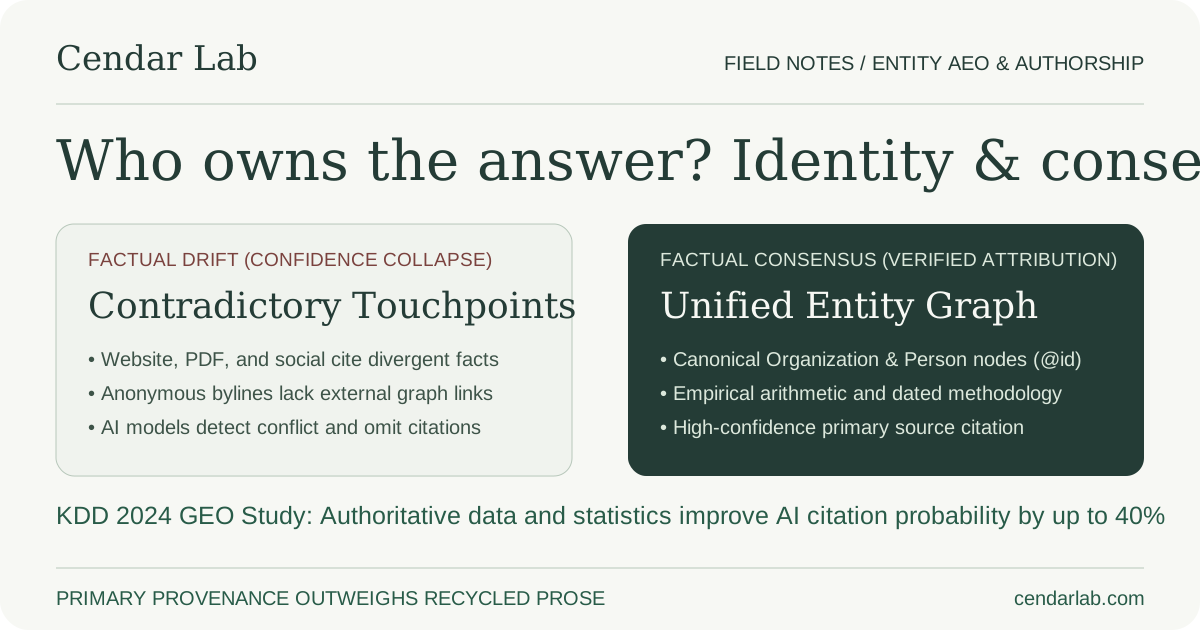
The short answer: attribution is determined by entity consensus, not bylines
In traditional web publishing, establishing authorship was largely an exercise in graphic design. A marketing team would format a clean byline above the article, display an author headshot, append a short biographical blurb, and assume that search engines and readers would credit the individual with the insights that followed. In the emerging architecture of generative AI search, this cosmetic approach to authorship has become entirely obsolete.
When an AI search engine—whether it is Perplexity, ChatGPT Search, Claude with web search, or Google’s AI Overviews—constructs an answer to a user query, it does not credit a source because of an attractive layout or a stylized author card. Attribution in generative systems is the mathematical outcome of an entity consensus algorithm. The retrieval system evaluates multiple candidate documents from across the web, extracts their core factual assertions, and scores each document based on entity authority, cross-platform corroboration, and empirical provenance.
If five different websites publish articles on the same technical topic, the language model does not arbitrarily pick the most popular domain or the page with the highest word count. It evaluates which source demonstrates primary ownership of the underlying data. A publication that introduces original benchmark measurements, defines a verifiable architectural mechanism, or presents reproducible code wins attribution over secondary publications that merely rewrite the original findings in generic prose.
Furthermore, modern language models evaluate the coherence of the entity behind the content. If the entity claiming authorship lacks verifiable identity links across external knowledge bases, or if its factual assertions conflict with established consensus without providing proof, the model’s confidence score for that source drops below the threshold required for explicit citation. To own the answer in conversational search, organizations must understand how entity reconciliation actually operates.
References: Google Search Central — Creating helpful, reliable, people-first contentGoogle Search Central — AI features and your websiteAggarwal et al. — GEO: Generative Engine Optimization (KDD 2024)
How language models resolve factual consensus across contradictory sources
To understand why some websites earn prominent citations in AI answers while others are completely ignored, we have to look at the claim-resolution mechanics of modern retrieval-augmented generation (RAG) pipelines. When a user issues a conversational prompt seeking factual or technical guidance, the answer engine executes a multi-stage consensus evaluation.
In the initial retrieval phase, the engine retrieves candidate text passages from ten to thirty independent URLs. The ingestion system decomposes each passage into atomic semantic assertions—structured tuples representing entities, attributes, relationships, and quantitative measurements. For example, if the query concerns database latency under load, the system extracts assertions like `[Database X, p99 latency, 14ms, concurrency: 500]` from Source A and `[Database X, p99 latency, 85ms, concurrency: 500]` from Source B.
When the retrieval engine detects a direct factual contradiction between sources, it does not flip a coin. It applies a multi-factor weighting model. First, it evaluates publication timestamps to determine whether one claim represents outdated historical data while the other reflects current platform architecture. Second, it inspects the methodological context: does Source A provide the exact test script, hardware specifications, and benchmark date, while Source B merely quotes an unsourced marketing claim?
Third, it checks for cross-document corroboration across independent knowledge graphs. If technical documentation from the database creator, peer-reviewed engineering papers, and third-party benchmark repositories all report latency figures in the 12ms to 18ms range, Source A is classified as corroborating consensus, while Source B is flagged as an outlier or hallucinated assertion. The language model synthesizes the answer using Source A’s data and explicitly cites Source A as the authoritative reference.
This claim-resolution mechanism explains why simply repeating an unverified assertion across dozens of thin blog posts fails to deceive modern language models. Generative engines do not count raw frequency of occurrence; they evaluate the network graph of corroborating independent sources. If fifty low-authority affiliate blogs all repeat an unverified statistic that traces back to a single misquoted tweet, while three established engineering laboratories publish contrary empirical measurements, the model weights the consensus of the three authoritative laboratories over the fifty derivative blogs.
References: Aggarwal et al. — GEO: Generative Engine Optimization (KDD 2024)Google Search Central — Creating helpful, reliable, people-first contentGoogle Search Central — AI features and your website
Empirical proof: what peer-reviewed research reveals about AI citation probability
The superiority of verifiable facts over marketing rhetoric is not merely an editorial preference; it is supported by empirical computer science research. In the foundational peer-reviewed paper on Generative Engine Optimization (GEO) presented at KDD 2024 by Aggarwal et al. (Princeton University, Georgia Tech, and IIT Delhi), researchers conducted extensive benchmark tests across thousands of search queries to measure how specific content modifications impact a website’s likelihood of being cited by generative engines like Perplexity and Google AI features.
The empirical findings of the study provide definitive guidance for technical content teams. The researchers demonstrated that incorporating authoritative statistics and quantitative metrics into content produced the single highest increase in generative citation visibility—improving citation probability by up to 40% across benchmark queries. Similarly, incorporating direct quotations from recognized industry authorities produced a relative visibility increase of up to 30%.
Conversely, traditional SEO tactics produced negative results in generative engines. The study demonstrated that attempting to optimize content through simple keyword stuffing—repeating the target search query multiple times throughout the prose without increasing substantive information—actually decreased generative visibility by 10% to 15%. Generative models penalize repetitive, low-entropy text because it consumes valuable context window space without providing novel factual tokens for synthesis.
The research reinforces a crucial architectural reality: language models are entropy-aware compression engines. A document that delivers dense, original, verifiable information is computationally easier and more rewarding for a model to quote than a fluffy, redundant article that takes five hundred words to say what could be expressed in one precise data table.
References: Aggarwal et al. — GEO: Generative Engine Optimization (KDD 2024)Google Search Central — Creating helpful, reliable, people-first content
Citation inversion: defending your content against scraper attribution
A major fear among engineering leaders and technical writers is what we term citation inversion: when an original investigative article or benchmark is scraped by high-authority news aggregators or content scrapers, and the generative engine ends up citing the secondary scraper rather than the original author.
Citation inversion occurs when a search engine’s entity resolution pipeline fails to identify primary provenance. This typically happens when the original publisher lacks an established entity knowledge graph, publishes without machine-readable timestamps, or fails to link author identities to verifiable external profiles. In that vacuum of provenance signals, the search crawler awards citation credit to the larger, better-known scraper simply because the scraper’s domain carries higher baseline PageRank.
To defend against citation inversion, engineering teams must establish immutable proof of origin. First, ensure your content is published with precise ISO 8601 timestamps in both visible copy and JSON-LD structured data (`datePublished` and `dateModified`). Second, ensure your article is crawled immediately upon release by submitting clean XML sitemaps with refreshed `<lastmod>` timestamps and utilizing Google Search Console’s URL Inspection API. Third, embed unique, non-fungible brand identifiers—such as named proprietary datasets, specialized formulas, and custom diagrams—that scraper bots cannot republish without revealing their derivative nature.
References: Google Search Central — Creating helpful, reliable, people-first contentGoogle Search Central — AI features and your websiteGoogle Search Central — General structured data guidelines
Cross-platform factual drift: the silent killer of brand authority
The single most pervasive failure mode we discover during enterprise AEO audits is what we call cross-platform factual drift. This is not an issue of poor writing; it is a structural governance failure where an organization publishes conflicting factual assertions across its various digital touchpoints over time.
Consider a typical high-growth B2B technology company. On its primary marketing website, the pricing page states that its enterprise tier starts at ‘$5,000 per month with annual commitment’. Meanwhile, a downloadable PDF product brochure published two years ago and still indexed on a cloud storage bucket lists the starting price as ‘$3,500 monthly’. In a developer documentation repository on GitHub, a configuration example implies that a key feature is available on the free tier, whereas a recent blog post by the VP of Product states that the feature was moved behind the enterprise paywall in 2025.
To a human visitor browsing a single page, these contradictions are rarely noticeable because a human only reads one asset at a time. But to an AI crawler, your entire digital footprint is ingested and evaluated simultaneously. When an autonomous agent or conversational engine crawls your website, documentation, PDF whitepapers, and social profiles, it aggregates all of these conflicting statements into its entity representation of your brand.
When a prospective enterprise buyer prompts ChatGPT or Perplexity with ‘How much does Company X cost and what is included in their enterprise plan?’, the language model encounters severe internal contradiction within your own primary domain. The model’s probabilistic confidence in your pricing facts collapses. Because generative models are trained to avoid stating falsehoods when confidence is low, the model does not attempt to guess which of your contradictory pages is correct. It either produces an evasive answer (‘Company X pricing varies and requires contacting sales’) or worse, it cites a third-party software review directory that published an estimated pricing table.
Cross-platform factual drift is catastrophic for brand authority because it turns your own marketing assets into weapons against your search visibility. Eliminating factual drift requires treating every published number, date, tier, and policy as an immutable database record that must be reconciled across every public document.
References: Google Search Central — Creating helpful, reliable, people-first contentGoogle Search Central — AI features and your website
Authorship as an entity graph node, not a plain text string
One of the most consequential evolutions in search engine architecture over the past five years has been the shift from string-based entity matching to graph-based entity resolution. In legacy SEO, an author was simply a string of characters stored in a database field: `author: 'Moisés Costa'`. Search engines had no reliable way to distinguish whether that string referred to a specific software engineer in Rio de Janeiro, a musician in Lisbon, or an academic in Madrid.
In modern semantic search and AI retrieval, authorship is treated as a typed entity node within a global knowledge graph. Google’s Search Quality Rater Guidelines and Helpful Content documentation place extraordinary emphasis on E-E-A-T (Experience, Expertise, Authoritativeness, and Trustworthiness). To evaluate E-E-A-T algorithmically, search systems must resolve who created the content and verify their historical track record in the relevant subject matter.
This is where Schema.org structured data becomes an essential operational tool rather than a cosmetic decoration. By defining your author as a typed `Person` entity within your JSON-LD markup, assigning that Person a permanent canonical URI (such as `https://domain.com/authors/moises-costa#person`), and populating the `sameAs` array with links to authoritative third-party entity profiles, you provide search engines with an unambiguous identity proof.
Authoritative entity links include verified LinkedIn profiles, GitHub accounts with public commit histories, ORCID researcher identifiers, Google Scholar profiles, published books on Google Books, and Wikidata entries. When Google’s Knowledge Graph reconciles these links, it connects your article not to an anonymous string, but to a verified human professional with established authority in software engineering, cloud architecture, or AEO. This entity connection directly enhances the algorithmic trust assigned to the page’s factual claims.
Conversely, publishing technical or commercial content under anonymous bylines—such as ‘Admin’, ‘Staff Writer’, or generic corporate brand names—actively penalizes your content in high-stakes informational queries. In domains covered by Google’s Your Money or Your Life (YMYL) guidelines, anonymous content is systematically down-weighted in favor of publications where named, verified experts take personal and professional responsibility for the assertions made.
References: Google Search Central — Creating helpful, reliable, people-first contentSchema.org — Structured Data Vocabulary StandardGoogle Search Central — General structured data guidelines
The mechanics of entity reconciliation in modern knowledge graphs
To build an effective entity strategy, technical teams must understand how search engines and AI knowledge graphs merge disparate web observations into a single coherent entity node. This process, known in computer science as entity reconciliation or record linkage, relies on probabilistic matching algorithms operating across multiple identity signals.
When a search crawler encounters a company or individual mentioned on the web, it evaluates several distinct feature vectors: lexical similarity (name spelling and variations), structural co-occurrence (mentions of founders, executives, headquarters address, and phone numbers), digital infrastructure (domain names, SSL certificate organizational details, IP addresses, and DNS records), and external reference corroboration (Wikidata Q-identifiers, Crunchbase profiles, SEC filings, and national corporate registries).
When an organization maintains strict consistency across all of these vectors—using the exact same legal name, canonical domain URL, executive names, and physical address across its website, Schema.org markup, social profiles, and registry filings—the entity reconciliation algorithm achieves a high confidence score. The search engine creates a robust Knowledge Graph node for the brand, complete with verified entity attributes, social profiles, and recognized areas of expertise.
However, when an organization introduces inconsistency—such as rebranding its public name without updating corporate registry filings, moving offices without updating Google Business Profiles, or allowing different subsidiaries to use divergent domain structures—the entity graph fractures. The search engine splits the organization into multiple weak, unlinked entity fragments. In this fragmented state, accumulated brand authority is divided, Knowledge Panels disappear from search results, and generative models frequently confuse the company with unrelated third parties.
References: Schema.org — Structured Data Vocabulary StandardGoogle Search Central — Creating helpful, reliable, people-first contentGoogle Search Central — AI features and your website
The E-E-A-T engineering protocol: engineering verifiable first-party claims
Transforming your content from generic marketing prose into an authoritative primary source that AI engines eagerly cite requires a fundamental shift in editorial and engineering methodology. We call this the E-E-A-T Engineering Protocol, and it is built upon three non-negotiable rules.
Rule 1: The Rule of Explicit Arithmetic. Never publish vague, qualitative claims where a precise quantitative measurement is possible. Instead of claiming that your software ‘dramatically accelerates build times’, state that it ‘reduced median CI build times from 14 minutes and 20 seconds to 3 minutes and 45 seconds across 42 consecutive production builds’. Always provide the arithmetic: state the sample size, the testing window, the baseline, and the exact delta. Language models quote arithmetic; they filter out adjectives.
Rule 2: The Rule of Dated Methodology. Always document the exact technical environment, software versions, and observation dates used to generate your findings. In our own technical guides, we explicitly state that tests were conducted on Bun v1.4.2, Next.js v16.2.9, and Ubuntu 24.04 LTS on September 17, 2026. This technical specificity serves two purposes: it signals to human readers that the work is rigorous and reproducible, and it signals to AI retrieval algorithms that the document represents a primary empirical observation rather than recycled legacy advice.
Rule 3: The Rule of Acknowledged Limitations. The clearest indicator of fraudulent marketing content is the claim of universal perfection. Real engineering involves trade-offs. Authoritative content explicitly documents its operational boundaries: where the tool fails, what configurations are unsupported, and under what conditions the performance advantage disappears. Google’s Helpful Content guidelines explicitly reward content that demonstrates genuine first-hand experience by explaining the nuances and edge cases that only a real practitioner would encounter.
References: Google Search Central — Creating helpful, reliable, people-first contentAggarwal et al. — GEO: Generative Engine Optimization (KDD 2024)
The cross-platform entity consistency audit: a step-by-step framework
To ensure that your brand and content are recognized as the authoritative answer across both traditional search and generative AI models, engineering and marketing teams should execute a comprehensive entity consistency audit following five structured stages.
Stage 1: The Digital Footprint Inventory. Catalog every public digital touchpoint owned or operated by your organization: primary domain URLs, subdomains, legacy blog archives, developer documentation repositories, GitHub organizations, package registries (npm, PyPI, Crates.io), social media profiles (LinkedIn, X, YouTube, Discord), public PDF whitepapers, and external directory listings (Crunchbase, PitchBook, G2, Capterra).
Stage 2: The Canonical Core Fact Sheet. Establish a centralized, version-controlled repository (such as a single markdown document or database table) that defines the authoritative truth for all corporate facts: official company legal name, trade names, founding date, headquarters address, leadership roster, exact product and service names, current pricing tiers, security certifications, and primary domain URLs. This document serves as the absolute standard of truth for all public communications.
Stage 3: Cross-Platform Reconciliation and Pruning. Audit every inventoried asset against the Canonical Core Fact Sheet. Identify and remediate all instances of factual drift. Where old blog posts or outdated PDF whitepapers contain deprecated pricing, obsolete technical claims, or retired service offerings, either update the content to reflect current reality or permanently decommission the assets using HTTP 301 redirects or HTTP 410 Gone status codes. Never leave conflicting historical claims online to confuse retrieval algorithms.
Stage 4: Machine-Readable Entity Implementation. Deploy fully validated Schema.org structured data across your primary website. Ensure that every page features a canonical `Organization` node with an immutable `@id` (e.g. `https://domain.com/#organization`) and a comprehensive `sameAs` array linking to all verified external profiles. Ensure that all technical articles feature typed `Person` author nodes linking to verified external professional profiles, and that every publication date is formatted in ISO 8601 with explicit timezone offsets.
Stage 5: External Entity Synchronization. Proactively update external knowledge bases that feed search engine entity graphs. Ensure your company’s Wikidata item (if eligible), Crunchbase profile, and official corporate registry entries match the Canonical Core Fact Sheet verbatim. Where third-party directories publish outdated or incorrect information about your services or leadership, submit official corrections to eliminate conflicting external signals.
References: Google Search Central — Creating helpful, reliable, people-first contentSchema.org — Structured Data Vocabulary StandardGoogle Search Central — General structured data guidelines
Decision matrix: managing authorship, claims, and entity verification
Use the following operational matrix to determine the appropriate entity architecture and authorship standards for different types of content across your organization.
| Content Type | Recommended Authorship Model | Entity Markup Requirements | Primary Risk of Neglect |
|---|---|---|---|
| High-Stakes Technical Guide / Architectural Field Note | Named human practitioner with established external credentials. | TechArticle schema with typed Person author node and sameAs profile links. | Content treated as generic AI-generated filler; excluded from authoritative AI citations. |
| Commercial Service Landing Page / Offer Overview | Institutional corporate authorship (Cendar Lab Organization). | Service and Organization schema with canonical @id and official sameAs links. | Entity confusion in Knowledge Panels; inability of AI models to summarize core commercial deliverables. |
| Company News / Product Release Announcement | Named executive or product lead accompanied by corporate publisher. | NewsArticle or BlogPosting with both Person author and Organization publisher. | Features misattributed to third-party reporting outlets rather than the primary creator. |
| Developer Documentation / API Reference | Institutional engineering team authorship with version-pinned timestamps. | TechArticle or WebPage schema with explicit softwareVersion and dateModified. | Language models quote obsolete API methods and deprecated parameters from stale versions. |
| Third-Party Industry Commentary / Market Opinion | Named specialist author with transparent disclosure of relationships. | Article schema with explicit citations to primary data sources under about/mentions. | Claimed opinions treated as unverified bias; excluded from balanced multi-perspective AI summaries. |
References: Google Search Central — Creating helpful, reliable, people-first contentSchema.org — Structured Data Vocabulary StandardGoogle Search Central — General structured data guidelines